
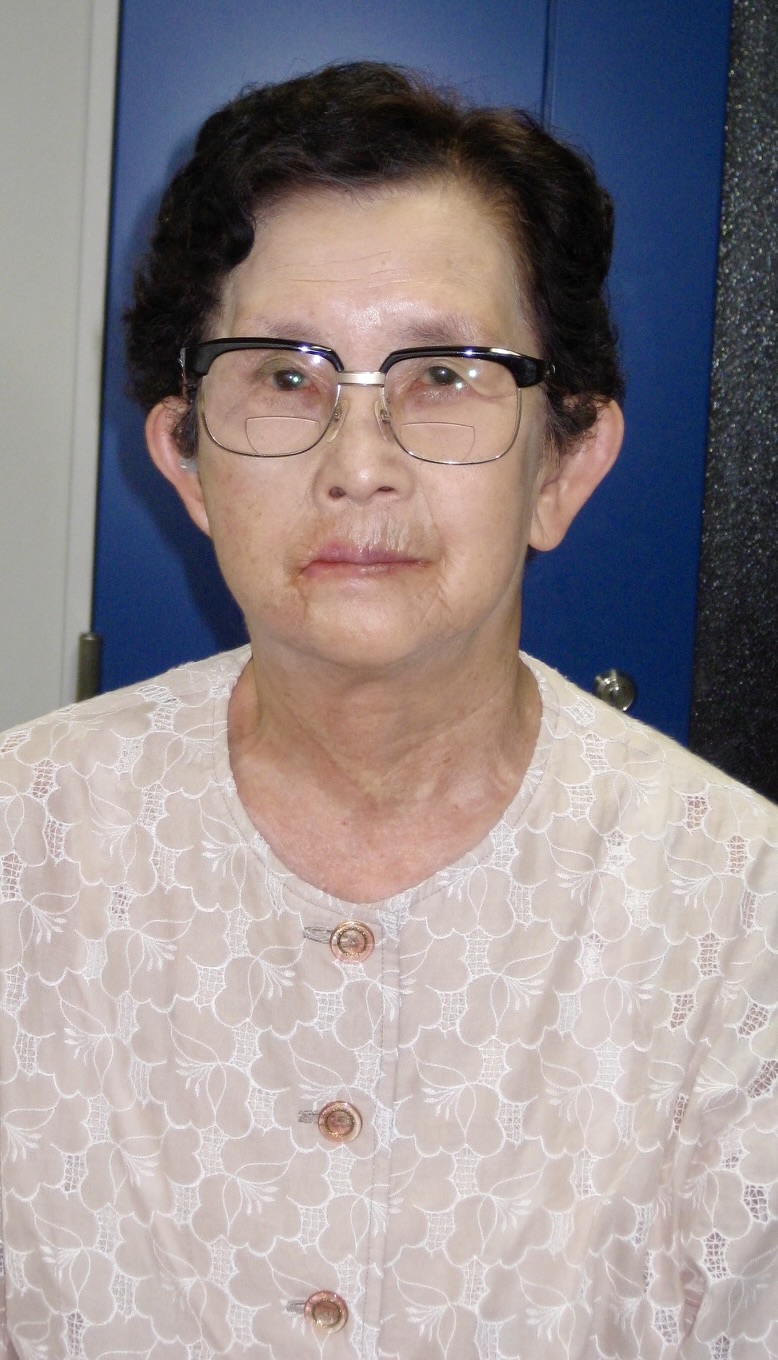
Badly injured by the atomic bomb, a young woman endured more than a dozen surgeries and raised a family while becoming a voice for peace and nuclear abolition. And she has been a witness to the hibakusha movement to abolish nuclear weapons. (Author photo, 2009)
By Joe Copeland
Abe Shizuko has long remembered the parents searching for their missing children in Hiroshima. Often, survivors say, the horribly burned children died without seeing their parents because they lay on the floor of the relief centers, at schools and other large buildings, too weak to respond when their parents called their names. And sometimes the parents could not recognize the burned, swollen faces of their children or recognize their shredded clothing. Abe, terribly burned, would have her own experience of the situation. But getting help for her physical wounds — which really couldn’t be fully addressed — would only be the slightest start toward the recovery and sense of purpose she would eventually know.
Despite her own injuries, she emerged as an early participant in the efforts of the survivors of the 1945 atomic attacks on Hiroshima and Nagasaki to organize themselves. And Abe, as she entered her late 90s, remains one of the hibakusha, as the survivors are called in Japanese, with especially long records of peace activism.
As she told me in a 2009 interview, she had been 18 and working with others on removing a roof as part of fire-lane clearing efforts when Hiroshima was attacked. She was about a mile (1.5 kilometers) from the bombing hypocenter, working with a volunteer group from a neighborhood where she was living with her in-laws (her husband was a service member fighting on the Asian mainland).[i] Her face was turned toward the bomb when it exploded, and she was knocked out. After coming back to consciousness, she fled the fire in central Hiroshima, walking about four miles despite her injuries before she came to a factory. “One person was using a megaphone and telling people that their clinic was open for the severely injured and burned,” she said. She thought that if she “could get any kind of treatment, my burns would probably get better.”[ii]
It was nearly noon, less than four hours since the bombing, and the factory was already too crowded with the injured to even get inside. And the only treatment people could get was oil applied to their burns with brushes. Still, even though there wasn’t any real help there, Abe said, “I felt I had lost all my strength, so I joined those people lying under the eaves of the factory. They looked like drying fish. Once I was lying down, I could not get up again. Those people lying on the ground, you could not tell if they were man or woman, young or old. They were crying, ‘Mother, Father. It hurts.’ ”
Abe was taken into the factory where she stayed for three days, running a high fever. “After three days,” she said, “I heard my father calling my name. I had a little strength to respond to his call. So, my father came to me. But my father could not believe it was me.” Probably because of her facial burns and maybe because of his shock at finally finding her, he was having a hard time recognizing her. She recalled him repeatedly saying, “Are you really Shizuko?” She added, “He asked me five or six times. Then he took me home by a cart.”
Their family home was about 10 miles from the bombing’s hypocenter but had some damage, she said. The family was still able to give her a place to rest, although her mother and father later told her that they would talk among themselves about whether she would die that day or the next. It would be 100 days before Abe was well enough to even crawl.
“I was 18 years old and I had been worrying how I looked after such a long period of treatment,” she said. “I crawled to the mirror.” The result would be the nightmare of any young person, both at first and in the months and years ahead. “After the burns on my face were somehow healed, my face was bright red, just as the face of the Japanese monkey,” she said.
It seemed too much. “I cried and cried many times, wishing to join those many people in Hiroshima who died that day.” The burns developed unusually thick, fibrous scars, known as keloids, which can develop on top of a healing wound and can be disfiguring. Although keloids can occur with any skin injury, sometimes months or a year later, they were unusually common among hibakusha, especialy those who received burns about 1.5 kilometers to 2 kilometers from the hypocenter.[iii] In Abe’s case, keloids distorted her mouth and pulled on the skin of her hands, making it hard to even hold a pen or chopsticks, as well as keeping her eyelids open even as she slept. As the keloids hardened, she could hardly blink and dirt would easily get into her eyes, causing infections.
Abe said the keloids grew thick and hard. “That is the first time I heard the term ‘keloid,’ ” she said. “I looked so terrible and the keloids grew,” she said. She didn’t want to leave the house, but there was no choice if she wanted to see the doctor. When she would go out, she said, “Cruel people jeered, ‘Here comes the red devil. Here comes the red devil.’ ”
It was a shock, in such contrast to the words of encouragement she had received from those closest to her. Abe had suffered second- and third-degree burns. Although she had been nearly a mile from the explosion, her face had received direct exposure to the heat. The bomb, as she recalled, initially heated up to 4,000 degrees for three seconds. “I was still young and I was severely injured,” she said, looking back from the perspective of six decades later. “My parents raised me with love very carefully until I became 18 years old. However, in an instant, my face was disfigured. And I had been crying day after day … my parents worried about me.
“One day, looking at me crying, my father hugged me very tight and said, ‘I wish you could have died that day with all the others in Hiroshima.’ And my father cried in front of me for the first time. So, for parents looking at their beloved daughter severely disfigured, they worried their daughter would suffer all her life. So, what my father said were the words of love.”

Her recovery would be difficult, with 18 operations to deal with the burns and keloids. Shortly before the bombing, however, Abe had been married to a young man, Abe Saburo, who was sent off to northeast China almost immediately. When he returned, both his parents and Abe’s parents told him that he should divorce his disfigured wife, who had been a pretty young woman. Saburo wouldn’t hear of divorce, saying that she would have stayed with him if he had been injured in battle. Together they raised three children. Her parents would both live to see her get through the operations and to find support and meaning in working for peace. Her father lived to age 76, and her mother lived to be 98.
Like many survivors, Abe met Barbara Reynolds, then a young American wife and mother whose husband came to Hiroshima for work. Reynolds became friends with many of the survivors. A deeply Christian woman, Reynolds, who founded the World Friendship Center in Hiroshima,[iv] a meeting place and hostel, and the Peace Resource Center at Wilmington University in Ohio,[v] came to believe that the hibakusha had something special to share with the world.
“When I met her for the first time,” Abe recalled, “my face was terribly disfigured. And I looked so terrible.” But, once she met Reynolds and the group around her, which included many hibakusha, she started to feel better. “I started to put my chin up. And the encounter with Barbara Reynolds is the engine that is driving me to give testimony. When I joined the peace movement with Barbara, my parents were very cooperative,” Abe said. “Since my fate was turned upside down by the atomic bombing, my parents thought that it was natural for me to devote myself to the peace movement.”
As noted articles in Hiroshima’s daily newspaper, the Chugoku Shimbun, Abe had also started to become active with other hibakusha in early efforts to support survivors and pursue peace efforts in the mid-1950s, just as the country was beginning to pay more attention to nuclear issues. The end of the U.S. occupation of Japan in the early 1950s brought an end to severe censorship of discussions of the bombings. Writing under a pen name, Eriko, Abe contributed one of 27 personal accounts to a groundbreaking 1953 book entitled Surviving the A-bombing (Genbaku ni Ikite) In her chapter, which took the form of a letter to a friend, she described the loneliness of feeling that her injuries would never heal as others built new lives in a more peaceful Japan that was starting to become more affluent.[vi] In her chapter, which took the form of a letter to a friend, she described the loneliness of feeling that her injuries would never heal as others built new lives in a more peaceful Japan that was starting to become more affluent.
As Abe, at age 98, recalled for an article in early 2025, she attended Japan’s first major international conference opposing nuclear weapons in 1955 (the World Conference Against Atomic and Hydrogen Bombs). There, in her hometown, she was struck by the warm reception conference participants gave the hibakusha attending the conference.“ I had been feeling depressed because people would say things to me as if to rub salt into my wounds, but the people at the conference were kind.”[vii] In 1956, she took one of her children, a son then 6 years old, with her to Tokyo as she joined a group urging the national government to enact the first law extending coverage of bomb-related health care expenses to some hibakusha. A poem she wrote during the campaign for support of the hibakusha would later become a song that was sung at anti-nuclear gatherings.[viii] It read: Place your hands with the warmth of the 10 o’clock sun/on the survivors who have forgotten how to smile amid their sorrow and suffering/ so that they may still feel glad to be alive.”[ix]
Over the years, Abe traveled internationally — including to Germany, Russia, and China — on peace missions, but her travel began with a mission to the United States that Reynolds organized. “Barbara Reynolds (was) a woman of courage,” Abe said. “So, she said that it was necessary to go the United States and appeal to the American public about the damage caused by the atomic bombing. The American public did not know the severe damage caused by the atomic bombing of Nagasaki and Hiroshima.”[x]
For a time, Abe held a grudge against Americans because the bombing had, as she put it, changed her fate totally. “However, after I visited the United States and was touched by the kindness … of the people, I started to pray that no one in the United States would ever be touched by the devastation of the atomic bomb.”
Reynolds had organized the 1964 trip in connection with the pacifist Quakers. “Those who took the leadership in inviting us were Quakers,” Abe said. “They took us to their churches, high schools, and universities. The audiences listened to us very seriously, and they were very surprised by our testimony. And we were very much moved by their response to our talks.”
Abe’s last trip abroad before our 2009 interview had been 10 years earlier, and it took her to China. She smiled as she talked about the differing perspectives, although she clearly found the Chinese views frustrating, “When I appealed to the Chinese people about the importance of the abolition of the atomic bomb, then the audience said they have to be prepared.” The Chinese knew their country had not been prepared when the Japanese attacked in the aggression that would lead the Pacific region into World War II.
“I said to them that peace cannot be created by the atomic bombs,” Abe said. “Then the Chinese people said that they will never use nuclear weapons unless they are attacked.” It was the Chinese version of the deterrence argument that goes back to the dawn of the atomic age’s first arms race, between the Soviet Union and the United States.
At the time we talked in 2009, North Korea had recently carried out its second nuclear test, which brought instant protests in Hiroshima. I asked her about the testing. “It is reckless,” she said. “It is reckless to carry out nuclear tests because it means all the other countries of the world will become North Korea’s enemy. It will not benefit North Korea.”
Of Reynolds, the woman who had drawn her into a life dedicated to peace, Abe said, “She had a strong will, and she was like a goddess.” Reynolds died in 1990.
When we talked, Abe shared with other survivors the hope spurred by a 2009 statement in Prague by President Barack Obama declaring that nuclear weapons should be abolished. Abe also mixed that hope with a keen feeling of the dangers of continuing to rely on war. The bomb dropped on Hiroshima was very small compared to the modern nuclear weapons, she said. And the numbers had grown from the two used in a single week against her country to the thousands held by the nuclear-armed states of North America, Europe, and Asia. “I think if the nuclear weapons will be used,” she said, “that will lead to the annihilation of all human beings.”
For herself, the years had brought personal peace with her injuries. “The redness, the brightness of my face, subsided somehow after so many years. So, now when I walk the streets, nobody looks at me. So, finally, at this age I have a very peaceful life.”
She continued to speak out occasionally in later years, although she said in the 2020 newspaper article that she had given up regular talks seven years earlier.[xi] In 2016, a few months after Obama did visit Hiroshima, North Korea again conducted a nuclear test. Abe, 89 at the time, told a reporter, “It’s a shame. I thought the world trend on nuclear weapons would change after U.S. President Barack Obama’s Hiroshima visit.”[xii]
In 2024 when she gave a speech while visiting an exhibition of bombing artifacts in Hiroshima, she voiced a mixture of hope and frustrations with military powers’ continued and even increasing reliance on nuclear weapons. She said that she prays young people will be able to live in peace and “reach the end of their lives with their beautiful skin unblemished.” Her activism, she said, “may have amounted to little more than shouting into raging waves in the dark of night. But I have met many people who have listened to my every word, and I have had a good life.”[xiii]
Copyright 2025 Joe Copeland
[i] Kuwajima Miho, “Survivors’ stories: Shizuko Abe, 92, Hiroshima: She suffered terrible burns but defied discrimination,” Chugoku Shimbun/Hiroshima Peace Media Center, Jan. 13, 2020, https://www.hiroshimapeacemedia.jp/?p=95941. Accessed April 17, 2023.
[ii] Author interview, Abe Shizuko at Hiroshima Peace Institute, interpreting by Kono Yoko, July 10, 2009. Except where noted, the interview is the source of Abe’s recollections.
[iii] Nagasaki University Atomic Bomb Disease Institute, Division of Scientific Data Registry, “The Medical Effects of the Nagasaki Atomic Bombing: Keloid,” no date given, https://www.genken.nagasaki-u.ac.jp/abomb/keloid_e.html. Accessed Nov. 3, 2023. The keloid entry is part of the online version of the Atomic Bomb Medical Museum, which is on the university’s campus.
[iv] Barbara Reynolds, The Phoenix and the Dove, Nagasaki Appeal Committee, 1986, p 6 and 40-41.
[v] “Peace Resource Center,” Wilmington College, no date given, https://www.wilmington.edu/the-wilmington-difference/prc. Accessed Jan. 28, 2023.
[vi] Shimotaka Michio and Mizukawa Kyosuke, ” “Documenting Hiroshima 80 years after A-bombing: In 1953, Genbaku ni Ikite (Surviving the A-bombing) published,” Chugoku Shimbun, https://www.hiroshimapeacemedia.jp/?p=151117. Accessed July 24, 2025.
[vii] Mizukawa Kyosuke and Miyano Fumiyasu, “Documenting Hiroshima 80 years after A-bombing: August 6, 1945, to 2025 — August 1955, World Conference Against Atomic and Hydrogen Bombs,” Chugoku Shimbun, March 16, 2025, https://www.hiroshimapeacemedia.jp/?p=150791. Accessed July 24, 2025.
[viii] Kuwajima, “Survivors’ Stories: Shizuko Abe, 92, Hiroshima.”
[ix] Oishi Rie, “A-bomb survivor: US hurt me, but also helped me to heal,” NHK World, July 24, 2024, https://www3.nhk.or.jp/nhkworld/en/news/backstories/3453. Accessed July 24, 2025.
[x] Author interview.
[xi] Kuwajima, “Survivors’ Stories: Shizuko Abe.”
[xii] “People in A-bombed cities, abductees’ families angered by N. Korean nuclear test,” Mainichi Shimbun, Sept. 9, 2016, https://mainichi.jp/english/articles/20160909/p2a/00m/0na/017000c. Accessed Jan. 29, 2022.
[xiii] Oishi, “A-bomb survivor.”