
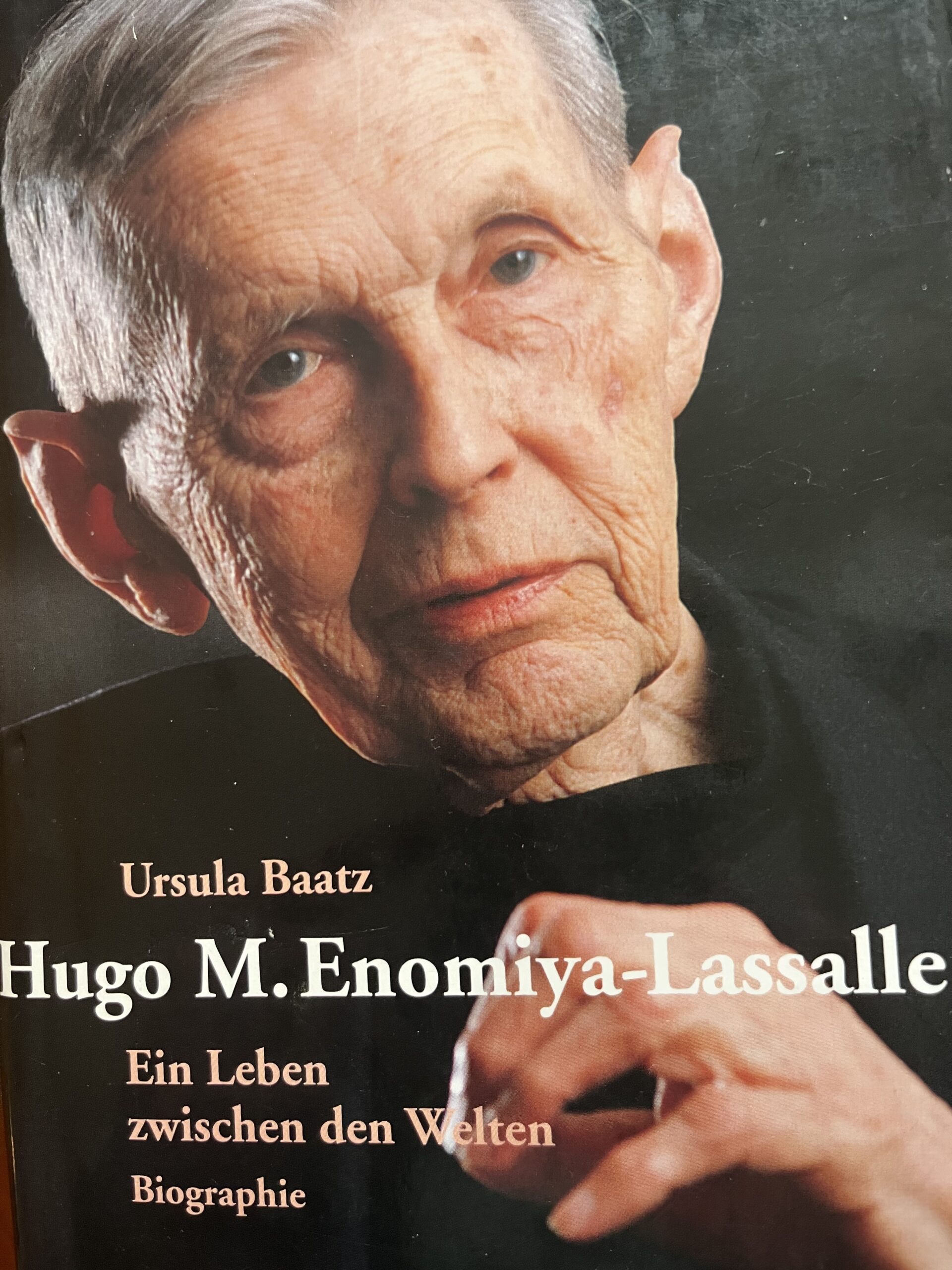
A Jesuit priest who survived the bombing of Hiroshima devoted his life to building a memorial cathedral for world peace and introducing Zen meditation to fellow Christians in Japan and the West.
By Joe Copeland
First of two articles on Hugo M. Enomiya-Lassalle
Update, Jan 16, 2025: Orbis Press is publishing author Ursula Baatz’s Jesuit and Zen Master: A Life of Hugo M. Enomiya-Lassalle. It took more than 20 years for the book to be published in English, and that apparently was due to the efforts of former California Gov. Jerry Brown.The book can be ordered directly from Orbis.
On the morning of Aug. 6, 1945, Hugo Enomiya-Lassalle, a Catholic priest, was getting ready to work, in a second-floor room of a European-style residence in Hiroshima. He was a busy man, leading the activities of all his fellow Jesuit priests in Japan. And it was surprising that he spent his time in Hiroshima, since Tokyo would have been a more logical choice, as the capital and the site of a Jesuit institution of higher education.
But Lassalle, while a learned man, was not an academic by nature, at least according to some of the priests who knew him. And he seems to have had an affinity for Hiroshima, where he had developed a network of friends across religious lines. His cross-cultural openness later led Lassalle to play a significant role in opening Europe to Japan’s tradition of Zen meditation. And in the early postwar years, he inspired an international effort to build a memorial church to world peace in Hiroshima.
A dedicated diary-writer, author of books on spiritual topics, and a popular public speaker in Japan, Europe, and the Americas over his long life, Lassalle tended to avoid giving details of his experience with the atomic bomb. When I met him in 1986, he was 87 and in Hiroshima for the August 6 memorial to victims, which he tried to attend annually. At our first meeting, he may well have been more interested in talking about the bigger issues he usually liked to discuss: peace, Zen, and the great hope he held in young people and humanity’s future. But, at least on this late afternoon the day before the 41st anniversary of the bombing, he jumped right into his memories of the bombing. And he proved willing to answer in detail when questioned about the specifics by a curious reporter and an interpreter from Tokyo, both of us Catholics.
We met Lassalle in a house on the grounds of a parish where Catholics had gained a foothold in the city by 1888, just 15 years after a centuries-long ban on Christianity had been lifted.[i]The sturdy, wood-and-mortar house reflected the construction and artisanship of Europe, where the Jesuits came from. Lassalle recalled that, on the morning of the bombing, he had already said daily Mass, and there had been an air raid warning that, after a while, was canceled. After having breakfast and saying his morning prayers, he went back upstairs to work in the two-story residence for priests.
Lassalle must have gotten to his desk just at 8:15 a.m., when the American bomb struck because, in the report I wrote for publication the next day in The Herald of Everett, Washington, he said that, before he could sit down, “I suddenly noticed there was some light outside, not so strong. But I thought there might be some experiment, because there were some (Japanese) army people around (the neighborhood).” Just then, though, “Everything came down on me … the windows, the ceilings and the chairs, everything mixed up. So, I thought this was the end.”[ii]
Speaking mainly in English but occasionally in German and Japanese, he said that after making his way outside, he found that the three other priests of the church in the Nobori-cho neighborhood and others who lived in the church complex had survived. He recalled encountering a cook who had been upstairs cleaning when the explosion hit. “Hello, Father. What is this?” said the cook, as confused as Lassalle about what could have happened.[iii]Lassalle helped dig out one of two women teachers who had been buried under debris of another house on the church property. Both women were rescued largely unharmed, along with the daughter of one of them.
About two hours after the bombing, Lassalle and others at the parish realized that a huge fire — which started after the bombing and was consuming much of the city — seemed to be heading their way. “We tried to go in the direction of the [railroad] station, which is about 10 minutes from here,” he recalled during the interview. But that route required crossing a bridge, he said, and everything on the other side was on fire.
They then made it to a nearby garden park, known as Shukkeien, whose history dates to the 1600s.[iv] There, the party from the church rested until evening, sending one of the young Jesuits, a theology student who was uninjured, to Nagatsuka, an outlying town several miles away where there was a residence house for young Jesuits receiving training. Lassalle was suffering from a severe cut on his leg and numerous cuts from glass shards. There was a considerable crowd in the park. “They had taken refuge there because there was no fire,” Lassalle recalled. He remembered that people looked frightened. “They were very much upset,” he said, “and didn’t know where to go.”
The Jesuit party stayed there until the minister of a nearby Protestant church, the Rev. Tanimoto Kiyoshi, took Lassalle and another priest by boat across the river. “From there, we could go to our novitiate,” Lassalle said, referring to the Nagatsuka center. A rescue party from there had made it to the river and was waiting when Tanimoto brought his friends across.
The team carried Lassalle on a stretcher and then in a handcart, finally reaching the novitiate at Nagatsuka at 1 a.m., he said.
Lassalle told me that a priest there, Father Pedro Arrupe, who had studied medicine before becoming a Jesuit, used a mirror to show him his injuries and the mud and dried blood on cuts. “I was quite surprised,” he said. He added, “I must say I was very lucky.” One slice of glass had just missed one of his eyes, another barely missed an artery in his neck. He had many of the glass shards for another 10 or 15 years, he said. He had certainly had some exposure to radiation, but noted he was inside the house and spared direct exposure to the initial burst of radiation. “I feel,” he said, “quite well.” And, he added with a gentle smile, “It was a narrow escape and that is a positive point.”[v]
His 1986 interview was a basic account, full of facts with a bit of emotion. One had to wonder if he had written more expansively about the experience somewhere. But his biographer, Ursula Baatz, writes that he left no detailed, personal description of his experience. I came across a reference to a Catholic news service 1960 interview with a Japanese broadcaster in which Lassalle is quoted as having given some details about his experience and may well have spoken at more length. Baatz notes a 1985 interview with a German broadcaster, NDR, in which he talked about his impression he was going to die in the collapse of everything around him in his room, and then thinking, “Now I will really know what heaven is like.”[vi] And in a book, Mein Weg zum Zen (My Path to Zen) he wrote a few sentences about the bombing, saying that, even when he realized that he had survived the initial blast in his room, he still thought he would die soon. My impression was that he was quite willing to talk about the bombing if directly asked but always had other topics that held more interest to him. So, Baatz, in writing about the bombing, draws mainly on the recollection of one of the other priests in Hiroshima on Aug. 6, Fr. Johannes Siemes.
There is, in contrast, quite a bit of historical record of the Jesuit priests’ experiences in Hiroshima as a whole, including in John Hersey’s Hiroshima, where Rev. Tanimoto and Fr. Wilhelm Kleinsorge, who was injured with Lassalle in the Hiroshima house, were among Hersey’s six central characters. While focused on Kleinsorge, moreover, Hersey account provides considerable detail of Lassalle’s experience that might otherwise have gone unrecorded, given Lassalle’s reticence about the subject.
—
As later interviews and research would show, Lassalle’s escape was, if anything, even more dramatic and difficult than he had let on in the 1986 interview. In 2009, Fr. Lawrence McGarrell, who as a young Jesuit had become friends with the older Lassalle, said that it must have been an extremely difficult journey for Lassalle as he was taken from Hiroshima to the refuge of the novitiate in Nagatsuka.[vii] At the time, McGarrell, who died in 2012, was the president and chancellor of the Elisabeth University of Music, on the same church property where Lassalle had been hurt and where Lassalle built the Hiroshima Memorial Cathedral for World Peace. And McGarrell lived at the property in Nagatsuka, which the Jesuits still owned. One day, after finishing work at the college, McGarrell took me in a car retracing the trip. Hiroshima, with roughly a million residents today, has long since spread out toward Nagatsuka.

Before heading out to Nagatsuka, McGarrell and I had walked from the university to Shukkeien, the public garden where the Jesuits gathered after the bombing. Hersey recounted that while Lassalle was badly hurt, another priest, Fr. Hubert Schiffer, was much more seriously injured than Lassalle, Kleinsorge, or a fourth priest at the residence, Fr. Hubert Cieslik. Schiffer had been hit in the head and was bleeding badly. Kleinsorge told a theology student, a young man from Nagasaki named Takemoto who had been at the Jesuits’ residence in Hiroshima, to go by boat and then make his way up to the Jesuit novitiate to have a rescue party sent for Lassalle, Schiffer, and the rest of them.[viii]
The drive to Nagatsuka was maybe five miles. Parts of the route — which took McGarrell an hour by bus on days when he didn’t drive — had changed because of diking and dam construction along the river. But it was clear that the rescue party would have faced a daunting walk at any time in Japan’s muggy summers, when even the nights are often oppressive.
Most of the route was flat but the land gradually rises from the delta where Hiroshima sits, reaching the pleasant green hills around the Jesuits’ Nagatsuka residence, where the rescue party took Lassalle. At the end of the war, there had been rice paddies along the way, but by 2009 the route was mostly suburban, with a heavy flow of traffic.
At Nagatsuka during the war, there were several priests as well as young Jesuits still studying for the priesthood as novices. Jesuit Fr. Klaus Luhmer, who had been in the novitiate there in August of 1945, recalled how the Jesuit order’s theology students in Japan were moved to the rural compound from Tokyo, as the dangers from the remorseless U.S. bombings of Japan’s major cities grew. Using a base in the Northern Marianas, U.S. bomber groups began reaching far enough into Japan to hit Tokyo on a regular basis beginning in November 1944.[ix] In a 2009 interview, when he was 92, Luhmer told me that the bombing had become so frequent that students could not really study. “You had to stay up at night,” he said. So, as the leader of the student group, he wrote to Lassalle, who approved a transfer of the students and their teachers to Nagatsuka.[x]
At Nagatuska on the morning of the bombing, Luhmer said, “I saw the airplanes coming and I also saw the explosion.” After seeing the frightening flash, the Nagatsuka group soon saw refugees making their way out of Hiroshima along the road near them. And they quickly began offering help, under the direction of Fr. Arrupe.
According to Hersey, when the theology student sent from Hiroshima arrived in Nagatsuka at 4:30 p.m., the Jesuits at the facility, who had been worrying about their colleagues in the city, hastily assembled two litters using wooden boards and poles that they could use to carry the injured Schiffer and Lassalle.[xi] A rescue party of a half-dozen young Jesuits, which included Luhmer, soon set out.
Luhmer must have been an imposing presence: In 2009 when he was living at age 92 in a pleasant health care facility for priests in the Tokyo suburbs, he still appeared tall — perhaps 6’2″ — and broad-shouldered. He had come to Japan at age 20, in 1937, first studying Japanese culture and language with the Jesuits before beginning his philosophy studies in 1938. Although Luhmer, who died in 2011 at age 94, said he had faced critical health problems from a blood ailment (some of which are fairly common among those who were in the cities on the day of the bombing or shortly after), he was sharp, funny, and clear in his memories of Lassalle, his role in the Jesuit order, and the bombing. The interview went on for more than the planned hour, and I worried that I had worn him out. Luhmer, though, cheerfully walked me and an interpreter a considerable distance to the front door of the facility’s complex and, in a farewell that I have always remembered, said he had been suffering from a fear of getting out of his usual surroundings but felt that our visit had pulled him out of that, and he would do more from then on.
When Luhmer headed into Hiroshima, on Aug. 6, 1945, he already knew Lassalle and Nobori-cho well, having served there as Lassalle’s secretary from July 1941 to September 1943, mainly handling his correspondence in the mornings. He said he had found Lassalle very human, someone who always had a sense of humor and was easy to approach and talk to.
The message that got to the Jesuits at Nagatsuka, as Luhmer remembered it, boiled down to: “Please come with a stretcher to pick up Lassalle and bring him out of downtown.” Luhmer recalled, “I went downtown to pick up Lassalle, who was unable to walk. He had a big injury in his leg, lost a lot of blood, probably.”[xii]

Trying to reach the park where the Hiroshima Jesuits had taken refuge, Luhmer and the rest of the rescue party had made their way along the river Ota, sometimes having to reroute themselves because of the intense heat from fires in the ruined city. When the rescue party arrived, Lassalle and the rest of the Jesuit group in Hiroshima were waiting in the park with other survivors, some horribly injured, all around them. Hersey recounts that the ground was littered with trees that had been blown down.[xiii] The park was largely silent, although sometimes people begged for water. The most seriously injured of the Jesuit priests, Schiffer, wrote briefly in a 1953 article about the time in the park, “We spent the whole day in an inferno of flames and smoke.”[xiv] Today, the park in which the Hiroshima Jesuits took refuge is green and pleasant, even in the heat of a summer afternoon.
When the rescue party arrived from Nagatsuka, they gave the waiting Jesuits and their friends wine and tea before talking about how to get Lassalle and Schiffer out of the city.[xv] “We found them OK near the mission station in Hiroshima,” Luhmer said in the 2009 interview. The priority, as Hersey wrote, was to take Schiffer and Lassalle out. Kleinsorge was relatively uninjured but feeling weak, so he decided to stay until the next morning when he could be taken to Nagatsuka. Fr. Cieslik said he could walk to Nagatsuka. Tanimoto had found a boat and begun ferrying people across the Ota River, and after the rescue party reached the city, Tanimoto gladly took the priests across to begin their walk to Nagatsuka with the rescue party.[xvi]
As they started the trip, Luhmer was one of the men carrying Lassalle on the makeshift stretcher. “I don’t know if you have any experience carrying a man on a stretcher,” Luhmer said.[xvii] “You need four people; three is not enough when it is a long distance. In an ordinary way it is about an hour walk from Nobori-cho to Nagatsuka. And this was not an ordinary walk. There was debris, there were telephone poles, the wires.” And, of course, it was dark.
“So, we put him on the stretcher, the four of us, and somehow we got out of town,” beyond the area that had been burned.
They had gone more than a mile, maybe two. Luhmer was one of the men carrying the left side of the stretcher, and a brook, maybe three feet or so deep, ran by the road on his side. Suddenly, a truck came at them, and it didn’t look like it was stopping. “So instinctively,” he recalled, “the people on the right side pushed and we all … including Lassalle, all fell down into that brook.” They climbed out, but the stretcher was in pieces. “We put Lassalle on the wayside, thinking what to do for now. Because he couldn’t walk.”
Luhmer looked at Lassalle and worried. “It looked like he was absolutely pale, and it could have been his last minute,” Luhmer said. Lassalle looked at the group and asked, “Would one of you guys have a cigarette?” It sounded to Luhmer like the dying words of a soldier, which Lassalle had been in World War I. “And I happened to have one,” Luhmer said.[xviii]
One member of the group, Hersey recounted, went ahead to the novitiate at Nagatsuka to get a handcart to transport Lassalle, but happened on one along the way.[xix] By the time he got back with the cart and they were ready to go again, it was perhaps midnight or 1 a.m. The group got Lassalle into the cart, on his back. “What we did not know at that time is that he had the whole glass of the windowpane [from the broken window in his room] in his back,” Luhmer said. He added, “He never uttered a sound. He must have had terrible pain.”[xx] It was another hour before they got back to Nagatsuka, where Fr. Arrupe took care of him.
In my second interview with Lassalle in 1986, I had asked him about the pain — perhaps I had revisited Hersey’s book before our meeting — and his recollection was less dramatic. He said the glass, firmly lodged in his back, was not very painful. As for the fall itself, he laughed, “I was dropped in a soft place.”[xxi]
—
It took another six weeks or so for Lassalle’s left leg to heal, Luhmer said. While recuperating at Nagatsuka over the late summer and fall, Lassalle said, he had the idea of building the World Peace Memorial Cathedral. He was 46 at the time. Lassalle and another priest returned to Hiroshima before the end of the year, setting themselves up in a little house, what the Japanese at the time came to call a barrack. By Christmastime of 1945, what was left of the parish congregation was again functioning and worshipping together. And Lassalle was able to move ahead with his idea of a cathedral dedicated to peace.
In a 1995 article recounting the history of the cathedral’s construction, Hiroshima’s Chugoku Shimbun noted that the Hiroshima house where Lassalle lived right after the war was barely 50 square feet. “The one-room structure, fashioned from galvanized iron sheets and wooden boards, served as both church, reception room, and then bedroom at night, with the occupant lying on a straw mat,” a reporter wrote. “The space under the altar, composed of merely a horizontal board, also served as a closet for the next morning’s necessities.”[xxii]
When asked in our first interview if he had ever thought of not coming back to Hiroshima to rebuild, he said, “No, never.” To be sure, as Baatz notes, most Japanese cities were not in much better shape, with the terrorizing American campaign of firebombing having left a third of all Japanese without roofs over their heads at the end of the war.[xxiii] Building the cathedral would become the focus of much of his work for nearly the next decade. After not having been able to contact his family members in Germany during the war much less consider leaving Japan,the reconstruction campaign would take Lassalle to much of the world. And it would keep him in almost constant motion within Japan.
Lassalle had at least two purposes in mind for the cathedral. Ishimaru Norioki, an engineering and architectural professor in Hiroshima who wrote a book about the church’s construction, said in a 2009 interview, “Fr. Lassalle wanted to console the souls of the dead and he also wanted to make a place where people can pray for peace.”[xxiv] Confirming the descriptions of Luhmer and others, Ishimaru said people he interviewed for his book about the Cathedral would all talk about Lassalle’s kindness.
There was probably another factor in Lassalle’s drive to build the cathedral: his interest in spreading Christianity or, as he might have put it, sharing his own experience of the transcendent. (Which, at one point in our first interview, he referred to as “God, if you will.”) Around the world and in Japan, many Christians — including Lassalle — dreamed that they might convert large numbers of Japanese to their religion. In the immediate postwar years, there was a widespread interest in Christianity among Japan’s population — a Japanese journal of religion referred to it as “a Christian boom.”[xxv] There were even suggestions, probably fueled in part by Emperor Hirohito’s repeated entertaining of foreign religious leaders and visits to Christian institutions in Japan, that the emperor would convert.[xxvi] The so-called boom faded within a few years. But a younger brother of the emperor, Prince Takamatsu, did take an enduring interest in Lassalle’s drive to build a cathedral dedicated to peace[xxvii] as did the leading liberal newspaper in Japan, Asahi.[xxviii]
Even with the high-level interest in the Cathedral, Lassalle faced skepticism about his grand idea. Hubert Cieslik, the priest who had suffered little injury in the bombing, later recalled that some of their fellow Jesuits objected to the idea of a cathedral as a foolish pipe dream.[xxix]Lassalle was undeterred, and when he was soon called to Rome for a meeting with fellow Jesuits, Baatz wrote that he took it as an opportunity to undertake international fundraising for the project. Intent upon the Cathedral project as well as using speaking engagements to spread the word about Hiroshima’s needs and even recruit missionaries, he headed to Rome by way of the United States, taking a ship to San Francisco, according to Baatz.[xxx] In New York, the Chugoku Shimbun recounted, he held a press conference as the first survivor of the bombing to visit the city. He said he would use the trip to ask the pope for support for Hiroshima and that he would tell the world about the city’s experiences.[xxxi]
The trip would take him through much of Europe, Argentina, and Brazil — where he spoke in Japanese to large crowds of 20th century emigrants who created the world’s largest Japanese ethnic population outside Japan[xxxii] — and then back to New York, and again across North America. He didn’t return to Japan until November 1947, and though there were several rebuilding projects he was overseeing as head of the Jesuits, he had established a committee at the Hiroshima parish to support the cathedral project. Lassalle’s trip gave the fundraising a head start. Eventually many of the materials for the church would be donated from around the world. The main altar was from Belgium, the bronze doors from Germany, and stained glass from Mexico, Austria, and Portugal. Ishimaru said that one especially large donation of $50,000 — which was important to finally launching the construction, according to Ishimaru — came from a New York business person, Thomas Bradley.[xxxiii]
In our 2009 interview, Ishimaru couldn’t provide any more detail about Thomas Bradley, whose name is fairly common in the United States. Many U.S. news outlets reported on the plans and construction of the cathedral, but all that I found omitted any mention of the donor’s name or, typically, described the donation as anonymous, as did a New York Times report in 1949.[xxxiv] But Ishimaru mentioned there might be a little more about Bradley in his book. And indeed there is an image of what appears to be a copper plate asking visitors to the cathedral to pray for all the cathedral’s benefactors, including especially the architect, Murano Togo, and Thomas A. Bradley. And the accompanying portions of the book mentioned a joyful visit to Hiroshima by Bradley and unnamed family members in 1962.[xxxv] My first real clue about Bradley’s identity was a 1962 obituary in the New York Times about Irene Talley Bradley. It mentioned that she and her husband, Thomas A. Bradley, founder of Acme Fast Freight, a pioneer in speedy shipping nationally, were both honored in 1956 by Pope Pius XII for their assistance to Catholic charities.[xxxvi] Searching online for names of survivors eventually led me to Renee Bradley Merz, a granddaughter, who immediately recognized such a donation as fitting with the family history. Family members soon found a letter to Thomas Bradley from a Jesuit colleague of Lassalle in Hiroshima telling Bradley how much he enjoyed the visit from him, a daughter and a son-in-law. It was dated 1962, the year of the visit mentioned in Ishimaru’s book.

Correspondence with Merz and cousins showed that Bradley had given to other church construction projects as well as a Catholic school in Hiroshima. But beyond his and his wife’s generosity to Catholic causes, Bradley may have felt a particular responsibility to help Lassalle, who could well have visited with him in New York while on a long international speaking trip. A Catholic News Service news item from 1949 reported that the anonymous donor had said, “Americans dropped the bomb, so Americans should help build the memorial.”[xxxvii]
It was the Bradley donation that allowed Lassalle, who had conceived the project three years earlier, to let construction begin in 1948. In 2025 terms, the $50,000 donation would be worth some $666,000.
Even so, construction costs required much more work for Lassalle, including further fund raising. The New York Times report in August 1949 said that the construction of the Peace Memorial Cathedral was underway, noting, “It is planned to have it ready by Aug. 6, 1950, the fifth anniversary of the bombing.”[xxxviii] That was wildly optimistic. The enduring problem for Lassalle, according to Baatz, was that the money he had gathered abroad was far short of what was needed. The design and construction of the church itself was also anything but easy. Early on, a committee, which included famous architect Murano Togo and Lassalle, set up a design competition among architects to construct the cathedral.[xxxix] They took the designs to the church membership, with the most attention going to one by Tange Kenzo, who designed the Hiroshima Peace Memorial Museum and would go on to win architecture’s most prestigious award, the Pritzker Prize.
Nobody was satisfied, however, Ishimaru recalled. “The people in the church thought that all the design plans were too modern, they are too Westernized,” he said. “There was no aspect that was Japanese. It was not what they were planning to build.” The committee, which had intended to award the project to the winning architect, ended up awarding Tange second place — with no first-place prize given. Lassalle then turned to Murano to take on the project himself, which he did as a labor of love.
For much of the years involved with design and construction, Baatz notes, Lassalle remained the administrator for all Jesuits in Japan.[xl] The project proved arduous, complicated by costs that rose well beyond what was originally envisioned, the need for further work on the design by Murano, problems with the work of contractors and the like.
With business and government leadership centered in Tokyo, moreover, Lassalle constantly had to go back and forth between there and Hiroshima for the Cathedral effort and, presumably, for his other responsibilities in the order. At the end of 1951, nearly a year and a half after the construction was supposed to be done, Lassalle calculated that he had made 27 round trips between Tokyo and Hiroshima.[xli] Most of the trips were on night trains, saving time and money, because he was willing to forego a sleeper compartment or even a reserved seat. Ishimaru recalled stories of how Lassalle would fold his tall, thin body into his seat and sleep.[xlii] But mostly Lassalle ended up standing on the crowded trips, around 500 miles each way.
At least once, Bradley would step in again to help. Baatz mentions Lassalle receiving a telegram from him in New York, in the early 1950s as construction struggled along, promising the donation of what she describes only as a “large sum.”[xliii] Given that wording, it would be easy to guess that the Bradley family’s donations to the cathedral totaled at least $1 million and perhaps $1.3 million in 2025 value. (The second donation may have been $50,000; a Time magazine article in 1954, when the cathedral was dedicated, said than an anonymous U.S. donor had given $100,000.[xliv]) Even so, the ballooning costs left Lassalle writing to a fellow priest that he felt like he was riding the rails for money.[xlv]

Despite all the challenges, the project proved a big success, earning widespread praise. Ishimaru said Murano listened to the local people, and he chose a concrete building that, while it wasn’t traditionally Japanese, offered protection against fire. But he also wanted to include many Japanese elements, creating a Japanese ethos, Ishimaru said.[xlvi] There’s a gate reminiscent of Shinto shrines’ torii gates at the start of the walkway to the front entrance. Before entering, the visitor crosses a small bridge, introducing water and its role as a purifying element in Japanese religions — and Christianity. Along with the statues of Christian saints, there are stained glass windows that feature images of bamboo, plum blossoms, and pine. A 2017 Murano exhibition at the Hiroshima City Museum of Contemporary Art noted the mixture of exterior surfaces — including bricks made with soil that contained ashes of the bombing’s ruins — and the fusion of Western and Japanese styles.[xlvii] The cathedral’s design and architecture has continued to attract serious study, including in a four-part series of articles published in the Japan Architectural Review beginning in April 2023.[xlviii]
It took until 1954 before the building was completed, with the dedication occurring on Aug. 6, the bombing’s ninth anniversary. The ceremony drew a huge crowd with high-ranking dignitaries from Europe; Japanese and American military officials; Prince Takamatsu who had done so much fundraising, and, as an Australian Catholic newspaper, The Southern Cross, noted at the time, a significant contingent of Buddhist monks.[xlix]
For Lassalle, Baatz recounted, the big festivities of the day were deeply moving, and he would recall in his diary the feeling of comfort. But the end of the day would also bring a shock: His superiors told him that, with the work done, he would no longer serve as pastor of the church, where he was deeply tied to the community. But he would continue to visit Hiroshima over the years, as he did when I interviewed him in 1986. In a speech during a visit there to mark the bombing’s 15th anniversary, he gave a clear indication of his ideas about peace beginning. He expressed concern about the politicization of some of the events around the anniversaries. “The victims of Hiroshima would not be happy if they knew that they were being used for political aims.” That was at a time of intense political fighting over relations with the United States, the Soviet Union, and China, which certainly may have influenced in his thinking. But in words that emphasized how his spiritual beliefs came first even as he pursued social issues at times over his career, he went on to say, “In order to keep peace in the world, we must attain peace in our minds.”[l]
[i] Ishimaru Norioki, Sekai Heiwa Kinnen Seido: Hiroshima ni miru Murano Tohgo no Kenchiku (The World Peace Memorial Cathedral: Murano Tohgo’s Building for Hiroshima), Sagami Shoboh, 1988, p 11-12.
[ii] Joe Copeland, “Blast could not destroy priest’s hopes for peace,” The Daily Herald, Aug. 6, 1986, p 1.
[iii] Author interview, Fr. Hugo Makibi Enomiya-Lassalle, Hiroshima, Aug. 5, 1986, Interpreter Shibata Ikuko.
[iv] Paul Walsh, “Shukkeien Garden,” Get Hiroshima, no date given, https://gethiroshima.com/museums-attractions/shukkei-en-garden. Accessed March 22, 2022.
[v] Author interview.
[vi] Ursula Baatz, H.M. Enomiya Lassalle: Jesuit und Zen-Lehrer, Brückenbauer zwischen Ost und West (H.M. Enomiya Lassalle: Jesuit and Zen-Teacher, Bridge Builder between East and West), 2004, Verlag Heider: Bergisch Gladbach, Germay, p 45.
[vii] Author interview. Rev. Lawrence M. McGarrell, S.J., Elisabeth University of Music, Hiroshima, July 30, 2009.
[viii] John Hersey. Hiroshima, Vintage Books, 1989, p 35-48. Hersey refers to it as Asano Park, a rarely used name now.
[ix] Philip A. Crowl, Campaign in the Marianas, Center of Military History, United States Army, Washington, 1993, p 443. PDF version at https://history.army.mil/html/books/005/5-7-1/CMH_Pub_5-7-1.pdf. Accessed March 23, 2022.
[x] Author interview, Rev. Klaus Luhmer, at a residence for priests in suburban Tokyo, in English and some Japanese with interpreter Shibata Ikuko, June 30, 2009.
[xi] Hersey, Hiroshima, p 43.
[xii] Author interview.
[xiii] Hersey, Hiroshima, p 43.
[xiv] Hubert F. Schiffer, S.J., The Rosary of Hiroshima, booklet published by the Blue Army, Washington, New Jersey, 1953, p 12. Electronic copy maintained by Sacred Heart University. http://digitalcommons.sacredheart.edu/cgi/viewcontent.cgi?article=1001&context=library_specialcollections. Accessed Jan. 18, 2023.
[xv] Hersey, Hiroshima, p 41.
[xvi] Hersey, p 44.
[xvii] Author interview.
[xviii] Author interview.
[xix] Hersey, Hiroshima, p 48.
[xx] Author interview
[xxi] Author interview with Hugo Enomiya-Lassalle mostly in English, Shibata Ikuko interpreting Japanese, at his Zen dojo, Shinmeikutsu, outside Tokyo, Aug. 21, 1986.
[xxii] Nishimoto Masami, “The Memorial Cathedral for World Peace,” Chugoku Shimbun/Hiroshima Peace Media Center, Aug. 1, 2012, originally published in Chugoku Shimbun, Dec. 16, 1995, https://www.hiroshimapeacemedia.jp/?p=27528. Accessed Jan. 23, 2023.
[xxiii] Baatz, H.M. Enomiya Lassalle, p 49.
[xxiv] Author interview, Ishimaru Norioki, at Hiroshima Peace Institute, interpreting by Yoko Kono, June 24, 2009.
[xxv] Reminiscences of Religion in Postwar Japan (First Installment). (1965). Contemporary Religions in Japan, 6(2), 111–203, http://www.jstor.org/stable/30233906.Accessed Oct. 10, 2023.
[xxvi] Ibid, p 142.
[xxvii] Nishimoto, “The Memorial Cathedral for World Peace,” Chugoku Shimbun/Hiroshima Peace Media Center.
[xxviii] Baatz, H.M. Enomiya Lassalle, p 57-8.
[xxix] Nishimoto, “The Memorial Cathedral for World Peace.”
[xxx] Baatz, H.M. Enomiya Lassalle, p 51.
[xxxi] Nishimoto, “The Memorial Cathedral for World Peace.”
[xxxii] Leticia Mori, “A little corner of Brazil that is forever Okinawa,” BBC News, Feb. 4, 2018, https://www.bbc.com/news/world-latin-america-42859249. Accessed April 11, 2023.
[xxxiii] Author interview.
[xxxiv] Preston King Sheldon, “Catholics Rebuild Hiroshima Church,” New York Times, Aug. 13, 1949, https://timesmachine.nytimes.com/timesmachine/1949/08/13/96469446.html?pageNumber=12. Accessed July 20, 2025.
[xxxv] Ishimaru, Sekai Heiwa Kinnen Seido, p 216-17.
[xxxvi] “Mrs. Thomas A. Bradley,“ New York Times, p. 35, Feb. 13, 1962. https://timesmachine.nytimes.com/timesmachine/1962/02/13/80380119.html?pageNumber=35. Accessed Jan. 23, 2023.
[xxxvii] “Catholic church in Hiroshima to be memorial to bomb victims,” the Catholic News Service, then known as the NCWC News Service, news feed of March 9, 1949, p 11. PDF version accessed through the Catholic News Archive via the New York Public Library, July 20, 2025.
[xxxviii] Preston King Sheldon, “Catholics Rebuild Hiroshima Church,” New York Times, August 13, 1949, p 12. https://timesmachine.nytimes.com/timesmachine/1949/08/13/96469446.html?pageNumber=12. Accessed Jan. 23, 2023.
[xxxix] Author interview, Ishimaru.
[xl] Baatz, H.M. Enomiya Lassalle, p 57.
[xli] Ursula Baatz, H.M. Enomiya-Lassalle: Ein Leben zwischen den Welten (H.M. Enomiya-Lassalle: A Life between Two Worlds), Benziger Verlag, Zurich and Dusseldorf, 1998, p 186-7. This is a longer and earlier work than H.M. Enomiya Lassalle: Jesuit und Zen Lehrer, which is the one generally used here. The 1998 work, which was commissioned by the Japanese Province of Jesuits, is a very deep dive into Lassalle’s diaries.
[xlii] Author interview, Ishimaru.
[xliii] Baatz, Enomiya-Lassalle, Ein Leben, p 188.
[xliv] Religion: Answering a challenge, Time, Aug. 16, 1954, https://time.com/archive/6884708/religion-answers-to-a-challenge. Accessed July 22, 2025.
[xlv] Baatz, Ein Leben, p 188. The telegram mentioned by Baatz was in August of either 1951 or 1952. She appeared to be writing about 1951, but the following paragraph refers to the donation occurring in the same year as the conclusion of the postwar peace treaty between Japan and the United States, which wasn’t signed in San Francisco until 1952.
[xlvi] Author interview, Ishimaru.
[xlvii] “The Prolific World of Togo Murano: From the Memorial Cathedral for World Peace,” Hiroshima City Museum of Contemporary Art. https://www.hiroshima-moca.jp/en/exhibition/togo_murano. Accessed Jan. 29, 2022.
[xlviii] Tomioka Yoshito, Tabata Chikako, and Uchikawa Izumi, Design Process of the Memorial Cathedral for World Peace (1954), Hiroshima (Part 1), by Togo Murano, Japan Architectural Review, April 10, 2023, https://onlinelibrary.wiley.com/doi/full/10.1002/2475-8876.12352. Accessed July 21, 2025.
[xlix] Frederick Hanson, “Atom-bombed Hiroshima’s ‘Peace Church,’” Southern Cross, Adelaide, Australia, Aug. 13, 1954 via Trove, National Library of Australia. http://trove.nla.gov.au/newspaper/article/167691724. Accessed Oct. 4, 2017.
[l] Survivor addresses Japan on 15th anniversary of first atomic holocaust, Catholic News Service, news feed of Aug. 15, 1960, p 10-11. Accessed Aug. 4, 2025.
Comments
One response
[…] Read part 1 on Enomiya-Lassalle here […]