
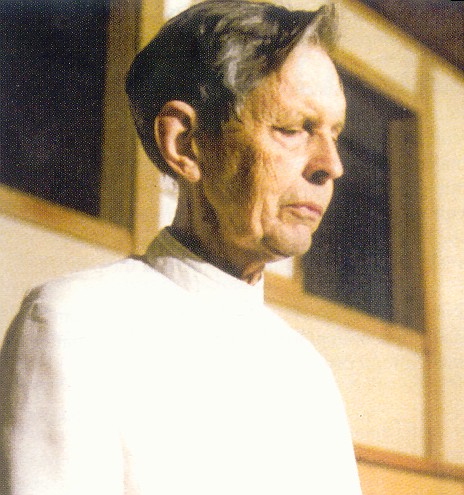
A Jesuit priest who survived the bombing of Hiroshima devoted his life to building a memorial cathedral for world peace and introducing Zen meditation to fellow Christians in Japan and the West.
Above: Hugo Enomiya-Lassalle in an undated photo. Source: Grentidez/Wikimedia Commons. Creative Commons license
By Joe Copeland
Read part 1 on Enomiya-Lassalle here
After the completion of the Hiroshima World Peace Memorial Cathedral, Jesuit priest Hugo Enomiya-Lassalle was unprepared to hear that he would be reassigned. With the painful break from his role in Hiroshima, Lassalle was at loose ends. According to his biographer, Ursula Baatz, he decided to spend four weeks in retreat at Nagatsuka, using the spiritual exercises practiced by Jesuits for centuries, to figure out a “a new start for the last chapter of my life.”[i]He thought about returning to Tokyo, where he had worked with the poor in settlement houses before the war. Or maybe he would become a member of one of Catholicism’s contemplative orders, spending most of his time in meditation and prayer.[ii]
But the Buddhist presence at the cathedral dedication had been much more than a courtesy: Zen monks had helped with the fundraising campaign in Japan. And in the middle of all the difficulties with the fundraising project, Lassalle had, Baatz wrote, turned more seriously to Zen — he had engaged in some meditation even before the bombing — to deal with the stresses. In addition to relaxation, he was looking for new forms of prayer and spiritual practice. And now, as he looked for a new course in life, Zen’s emphasis on meditation and losing oneself in the transcendent took a new hold in his mind.
Lassalle, Baatz noted, wrote in his diary about his desire to “partake of God’s nature — endless happiness.”[iii] In Japanese Buddhist tradition, meditation’s ultimate goal is to experience the absolute, or the Buddha. That was one reason for his interest in Zen. The other, she wrote, was that he sensed in the Zen monks an interest in Christianity, and that their quest was similar to Christian mystics’ search for an experience of unity with the transcendent.[iv] And, as Luhmer would recall, Lassalle was always an evangelist on behalf of Jesus who wanted to bring God to people,[v] but also, it would seem, someone who wanted to draw others to Zen, within the context of Christianity.
Lassalle’s road to integrating Zen into his practice as a Roman Catholic priest would be a long one that began in Hiroshima but had deeper roots in his own interest in mysticism and the transcendental. His own personal spiritual quest grew from his earliest days as a member of the Jesuits, which he had decided to join while recovering from injuries he suffered as a German soldier during World War I. One day as a Jesuit student he found himself in a dining room suddenly touched with such a powerful sense of deep comfort that it was a richly joyful, even mystical experience. It would prove a lifelong signpost for him, with the experience giving his life depth and direction, Baatz writes.[vi]
Lassalle’s pursuit of spiritual enlightenment and Catholic-Buddhist dialogue fit with his ideas about peace, social justice, and a healthy society. In his personal writings and discussions with others during the postwar years, he emphasized, as Baatz shows, the importance of religious thinking and the view that union with God is the purpose of humanity in achieving peace, a healthy society and freedom from the obsession with money.[vii] And both the social issues and meditation fit with his longstanding interest in mysticism.
Preparing for his assignment as a missionary in Japan, Lassalle was sent to France to be directed by Fr. Louis Poulier, who had been a missionary in Asia. Poulier, too, was interested in Christian mysticism, and he introduced Lassalle to the writings of such figures as Teresa of Avila and John of the Cross. Around the same time as Lassalle’s entry into the Jesuits, popular interest in mysticism had grown up among churchgoers in Europe, and the writings of Meister Eckhart, a Dominican monk and theologian who died in 1328, were translated into modern German. Eckhart, Baatz points out, became a bestseller in the years right after World War I.[viii] Throughout many of Lassalle’s later writings, Eckhart would be a touchstone as the Jesuit sought to explain his belief in the relevance of Zen to Christianity.
Lassalle’s actual study of Zen began somewhat circuitously. In the winter of 1939, Lassalle and a Hiroshima philosophy professor, Eto Taro, had founded a study group looking at the works of Catholic authors, according to Baatz. His conversations with the university professors in the group led Lassalle to start reading books about Zen.[ix]
Jesuit Father Klaus Luhmer, who served as Lassalle’s private secretary for a time in the early 1940s, said somewhat wryly that Lassalle never tried to convert him to Zen. But he recalled that it was around then that Lassalle took part in his first full sesshin, or Zen retreat. That was at a temple of the Soto branch of Zen Buddhism in February of 1943, according to Baatz.[x] Like other monasteries, the Temple of Eternal Light had no heating against the bone-chilling winter, other than small hibachis, three of which were brought to his room. Lassalle immersed himself in days of sitting in Zen meditation and the retreat’s talks, work, and meals. The retreat near Hiroshima left him impressed by the similarities to the Jesuits’ own rigorous retreats — as well as desperately sore from the long periods of zazen, sitting in the legs-folded Zen meditation position. After the retreat, Lassalle told another Jesuit, “Now I know what purgatory is.”[xi] But he continued to find Zen interesting. Father Larry McGarrell, a Jesuit who was president of Elizabeth University of Music in Hiroshima, said one factor in Lassalle’s involvement in Zen was simply that instruction was readily available there.[xii]
So, in the mid-1950s as Lassalle struggled with the blow of his removal from the cathedral parish, he was positioned to turn to Zen in a big way. It would become a lasting commitment, as he concluded that the goals and experiences of the mystical in Zen were very similar to those of the Christian mystics he studied. “Under this assumption,” Baatz wrote, “he engaged himself ever more deeply in the practice of Zen over the next 30 some years until his death. Again and again he ran into personal and institutional conflicts, but that did not deter him from his path.”[xiii]
In June 1956, Lassalle took part in a full-week retreat led by Harada Sogaku, one of the era’s most famous Zen teachers, or roshi.[xiv] In the fall of the next year, Lassalle, then 59, decided to make the roshi, who was already well into his 80s, his personal master in the study of Zen.[xv] Shortly before that, Baatz noted, he had received approval from the current head of the Jesuits in Japan, to write a book about Zen and Christianity.[xvi] The Jesuit leader was Arrupe — the priest and onetime medical student who had treated Lassalle and many other survivors at Nagatsuka. Arrupe also gave his blessing to the idea of building a small retreat center near Hiroshima for Zen sessions for Christians.
Lassalle moved forward with writing his book, Zen Weg zur Erleuchtung (The Zen Way to Enlightenment), and, when he submitted it to church officials for review, received the necessary approvals from church officials.[xvii] The volume was published in the fall of 1960 by a major German publisher, Herder. Vatican Radio, the church’s own station, aired a favorable commentary.[xviii] McGarrell described it as “a simple little guide to Zen for Christians”; it included, at least in later editions, pictures and illustrations to explain to Westerners some of the basic sitting in Zen meditation.

Shortly after the book’s publication, Baatz recounts, Lassalle bought a piece of land for the planned retreat center. At the end of 1960, Lassalle reflected in his diary on how much reason he had for gratitude in the successes of the year, and he looked ahead to more progress. “Deo gratias!” he wrote — Thanks be to God. [xix]
Within days, however, he received word from Arrupe of a letter from the Rome-based head of the entire Jesuit Order sharply limiting any teaching of Zen and denying permission to publish the book — even though it had already been published. This reversal, McGarrell said, was “quite a disappointment” for Lassalle. At the Jesuit facility in Nagatsuka outside Hiroshima, Arrupe sang a Spanish song and performed a dance from his homeland of Spain to cheer up Lassalle, McGarrell said.[xx]
Although feeling that he had been thrown into another crisis, Lassalle tried to figure out a course forward in the face of the objections by church censors — two in Rome, two in Japan. Arrupe, later to head the Jesuit order worldwide and a continuing source of support for Lassalle, advised him to work on figuring out much room the church authorities might allow for the practice of Zen. Encouragingly, Arrupe’s instructions from the then-secretary general of the Jesuits in Rome, Jean-Baptiste Janssens, also said that Lassalle should continue to practice Zen and figure out a way to relate to Japanese culture through Zen.[xxi]
The church was about to change its own course, in a direction which would be much more along the path of Lassalle’s thinking. A new pope, John XXIII, was intent on modernizing the church and he summoned the bishops of the world to meet with him in a council to review the church’s place in the world. Lassalle was soon sent to Rome to accompany the bishop of Hiroshima as an adviser at the gathering, the Second Vatican Council.[xxii] This is the council that would proclaim the church’s respect for other religions and its openness to the kinds of cross-cultural understanding that Lassalle was pursuing. (One of the best-known reforms from the Vatican Council was the practice of saying Mass in the local language rather than Latin, something Lassalle had been advocating for Japan since the 1930s.)
While he was in Europe for the church council, Lassalle got detailed information about the censors’ concerns, and with some minor revisions he won approval for new editions of his book on Zen.[xxiii] Young Jesuits in Japan would also receive broader training in Zen, and Lassalle offered retreats for the general public in his retreat center, which had been built near Hiroshima in 1961 and later moved to Tokyo as he eventually took up residence at the Jesuits’ Sophia University. Over time, McGarrell said, it came to be accepted that the church had to be “opening our eyes to the world, and the people in the world, including their spiritual quest,” he said. “The church is on a mission, of course, always and everywhere, bringing the good news. Part of that is preaching, and part of that is hearing.” The listening to other cultures leads to speaking more appropriately to the rest of humanity, McGarrell said. And it lets the church take in valuable aspects of other faiths. “One of the most important has been Zen practice,” he said.[xxiv]
For Lassalle, it would take years of retreats and practice in meditation to advance in Zen before, eventually, a new Zen master based near Tokyo in the ancient city of Kamakura would recognize him as a Zen teacher in 1972. The master, Yamada Koun, had already begun to have an influence extending to North America because of his willingness to teach Christians, some of whom had been introduced to Zen by Lassalle. Among them was a young future governor of California, Jerry Brown, who studied under both men.[xxv] Yamada, who spoke English with students who couldn’t receive instruction in Japanese, was very important to what McGarrell called the “great opening up of Zen within the church.”
Lassalle had already started to achieve a following in Europe, particularly among young people. By the early 1970s, hundreds would attend his lectures on Zen when he was visiting back home in Germany or coming to Rome or other cities for meetings. Lassalle dressed in the plainest of black clerical clothes, threadbare in keeping with his dedication to poverty and humility. Baatz quotes a description of him from one person attending a lecture: “A tall, slim man goes to a desk. After a few introductory words, he pointed us to some possibilities for sitting there, swung himself up on the table, sat still — meditated.” Because that was the point.[xxvi]
Over time, many of those Jesuits and young Westerners who studied Zen at least in part because of Lassalle would spread and start their own initiatives. After learning Zen in Japan, a Roman Catholic nun from Canada, Sr. Elaine MacInnes, pioneered meditation among prison populations in the Philippines and England. In the United States, Fr. Robert Kennedy, a Jesuit based in New Jersey, and Ruben Habito, a longtime theology professor at Southern Methodist University, have helped spread the practice of Zen among Christians. In Europe, Baatz’s book has been translated into several languages. Zen centers tracing to Lassalle or his students are in many European cities, and the Jesuit-sponsored Lassalle-Institut and Lassalle Haus, both in Switzerland, work on such projects as interreligious dialogue, ethical issues, and meditation.
In Hiroshima, the peace cathedral that Lassalle created, remains a tourist attraction as well as the home of active Japanese and international congregations. And the church which is also known as the Assumption of Mary Cathedral, sponsors peace-related events, including programs around the time of the anniversary.

Ishimaru Norioki, a professor who wrote a book about the Hiroshima World Peace Memorial Cathedral, says many modern Japanese buildings with straight lines and concrete like the Peace Memorial Cathedral look good in their first years but tend to lose their attractiveness after several years. “However, in Mr. Murano’s building, it looks better and better,” Ishimaru said. “It has a special atmosphere.” Along with the city Peace Memorial Museum, it became the first postwar building to be designated by Japan as an “important cultural property.”[xxvii]
For all Lassalle’s influence, as Baatz describes, he struggled at times to fit his own understanding of Zen’s value into his life as a priest and a member of the Jesuit order. It was never an easy undertaking in the often-conservative church, and despite all the openness to new ideas and academic pursuits, life in the Jesuit order also presented him challenges. For the magazine America, Jesuit William Johnston, one of the most prominent Christian writers on Zen, and Japanese novelist Shusaku Endo, whose book “Silence” was the basis of a Hollywood motion picture, once talked about what it was like for Lassalle to be a pioneer bringing Zen into Catholicism. Endo suggested that Lassalle’s Zen practice must have seemed heretical to his fellow missionaries. Johnston denied it but acknowledged that it was considered “progressive.” And he said, “Some considered it dangerous.”[xxviii]
And the feelings toward Lassalle within the order weren’t always warm, even from some of those who shared his interest in Buddhism. Jesuits pursue their studies seriously, forming strong opinions, whatever they might feel about a person as an individual. After an interpreter and I scheduled an appointment with Fr. Kadowaki Kakichi, S.J., at Sophia University in 2009, he called the interpreter just beforehand and suggested we cancel the meeting. Kadowaki, who practiced Zen himself and developed a reputation as a writer about Buddhism and Christianity, basically said that he didn’t want to say anything critical of Lassalle’s practice of Zen but indicated that he thought Lassalle had gotten Zen all wrong.[xxix] For a time after Lassalle’s death, Kadowaki had himself taken over the Zen retreat house that Lassalle had built outside Tokyo. Kadowaki did go ahead with the interview, but it was quite brief and unenlightening. He praised Lassalle as a missionary, someone who wanted to share Jesus Christ with people. And he referred me to Luhmer as someone who had known Lassalle well and could talk about him.[xxx]
Luhmer, similarly, praised Lassalle as a missionary, but he also said that he had never forgotten Lassalle’s vetoing of his own idea of delving deeply into Buddhist studies, as a scholar, something that his superior, with his missionary orientation, just didn’t get. Luhmer put Lassalle’s motivation to learn Zen in the context of the desire to bring people to Christ. Luhmer said, “He had the idea when he came to Japan: What can we do to reach the soul of the Japanese? … And people around him suggested to him to really know the Japanese soul and heart, you have to study Zen. And Zen is not something to study. Zen is something to practice.” He added, “He was a missionary at the bottom of his heart.”
“He was basically the missionary, no matter how far he went into Zen or Buddhism,” Luhmer said. He added, “He wanted to be with Christ … and to introduce people to Christ.”[xxxi] The description seemed notably formal, accurate but not very reflective of Lassalle’s wide-ranging mind and interests.
Another Jesuit, Fr. Klaus Riesenhuber, somewhat echoed the description of Lassalle, although in the context of a friendly relationship the two had developed. Riesenhuber said Lassalle was more interested in the practice of Zen — and its religious and spiritual applications — than in research. While still studying in Germany as a young man, Riesenhuber wasn’t impressed with Lassalle the first time they met, but that changed after he was assigned to Sophia University in Tokyo, where Lassalle was based after his Hiroshima years. Riesenhuber took up Zen as he pursued a rich academic career as a professor of philosophy at Sophia and author. Riesenhuber, who took charge of Lassalle’s diaries after his death and later ran his Zen retreat house, described him as a person of tremendous energy, always willing to collaborate and help anyone who needed assistance with something. And he traced a rich lineage of Zen practitioners who studied with Lassalle and then went to Europe or the Americas.[xxxii] One of them, Habito, at Southern Methodist University’s Perkins School of Theology, wrote, “It was Father Lassalle’s pioneering efforts in directing Zen retreats in Europe that enabled many Western Christians to see the possibilities of deepening their spiritual life in the practice of Zen.”[xxxiii]
While he remained a committed Catholic, Lassalle’s idea of mission had evolved dramatically over the years. Zen had become a focus, within his vision of Christianity, along with a drive for peace. And, while he had grown up in a time of very traditional thinking about religion in Europe, he embraced new ideas until the end of his life. During our 1986 interviews, for instance, he said he didn’t worry about the secularization of Europe but instead celebrated that people were pursuing spiritual interests. And, as he put it in a phrase that would become increasingly common after his death in 1990, they were developing “a new consciousness” — one that, as he saw it, was necessary to live in a world with such dangers as atomic weapons.
[i] Baatz, H.M. Enomiya Lassalle: Jesuit und Zen-Lehrer, Brückenbauer zwischen Ost und West” (hereafter Jesuit und Zen-Lehrer), p 63.
[ii] Ibid, p 64.
[iii] Ibid, p 64.
[iv] Ibid, p 64-5.
[v] Author interview, Luhmer.
[vi] Baatz, H.M. Enomiya-Lassalle: Jesuit und Zen-Lehrer, p 29.
[vii] Baatz, Enomiya-Lassalle: Ein Leben, p 193-195.
[viii] Ibid, p 31-3.
[ix] Ibid, p 42.
[x] Ibid, p 43.
[xi] Ibid, p 42-3.
[xii] Author interview, Lawrence McGarrell, S.J., at Elizabeth University, Hiroshima, July 29, 2009.
[xiii] Baatz, Lassalle: Jesuit und Zen-Lehrer, p 64.
[xiv] Ibid, p 65.
[xv] Ibid, p 73.
[xvi] Ibid, p 73.
[xvii] Ibid, p 73-76.
[xviii] Ibid, p 78.
[xix] Ibid, p 78.
[xx] Author interview.
[xxi] Baatz, H.M. Enomiya-Lassalle: Jesuit und Zen-Lehrer, p 78-80.
[xxii] Ibid, p 80.
[xxiii] Ibid, p 89-90.
[xxiv] Author interview.
[xxv] Trevor Carolan, “Jerry Brown and the Art of the Possible,” Shambhala Sun, September 2000, https://www.lionsroar.com/jerry-brown-zen-and-the-art-of-the-possible. Accessed March 25, 2022.
[xxvi] Baatz, H.M. Enomiya-Lassalle: Jesuit und Zen-Lehrer, p. 99.
[xxvii] “World Peace Memorial Cathedral,” ArchEyes online magazine, March 26, 2016, https://www.hiroshima-navi.or.jp/en/post/007297.html. Accessed March 25, 2022.
[xxviii] “Endo and Johnston talk of Buddhism and Christianity,” America, Nov. 19, 1994, p 18-20, based on a translation by William Johnston, S.J. of a conversation between him and writer Endo Shusaku. Originally published in Japanese by Bungeishunjusha. Found through the National Taiwan University Center for Buddhist Studies. http://ccbs.ntu.edu.tw/FULLTEXT/JR-EPT/william1.htm. Accessed March 25, 2022.
[xxix] Personal communication to the author from interpreter Shibata Ikuko, June 11, 2009.
[xxx] Author interview. Rev. Kakichi Kadowaki, S.J., Sophia University with interpreting by Shibata Ikuko, June 11, 2009.
[xxxi] Author interview, Luhmer.
[xxxii] Author interview, Fr. Klaus Riesenhuber, S.J., at Sophia University in Tokyo, mostly in English, with interpreter Maeda Akiko, May 14, 2009.
[xxxiii] Ruben L.F. Habito. Living Zen, Loving God, Wisdom Publications, Boston, 2004, p 116.