
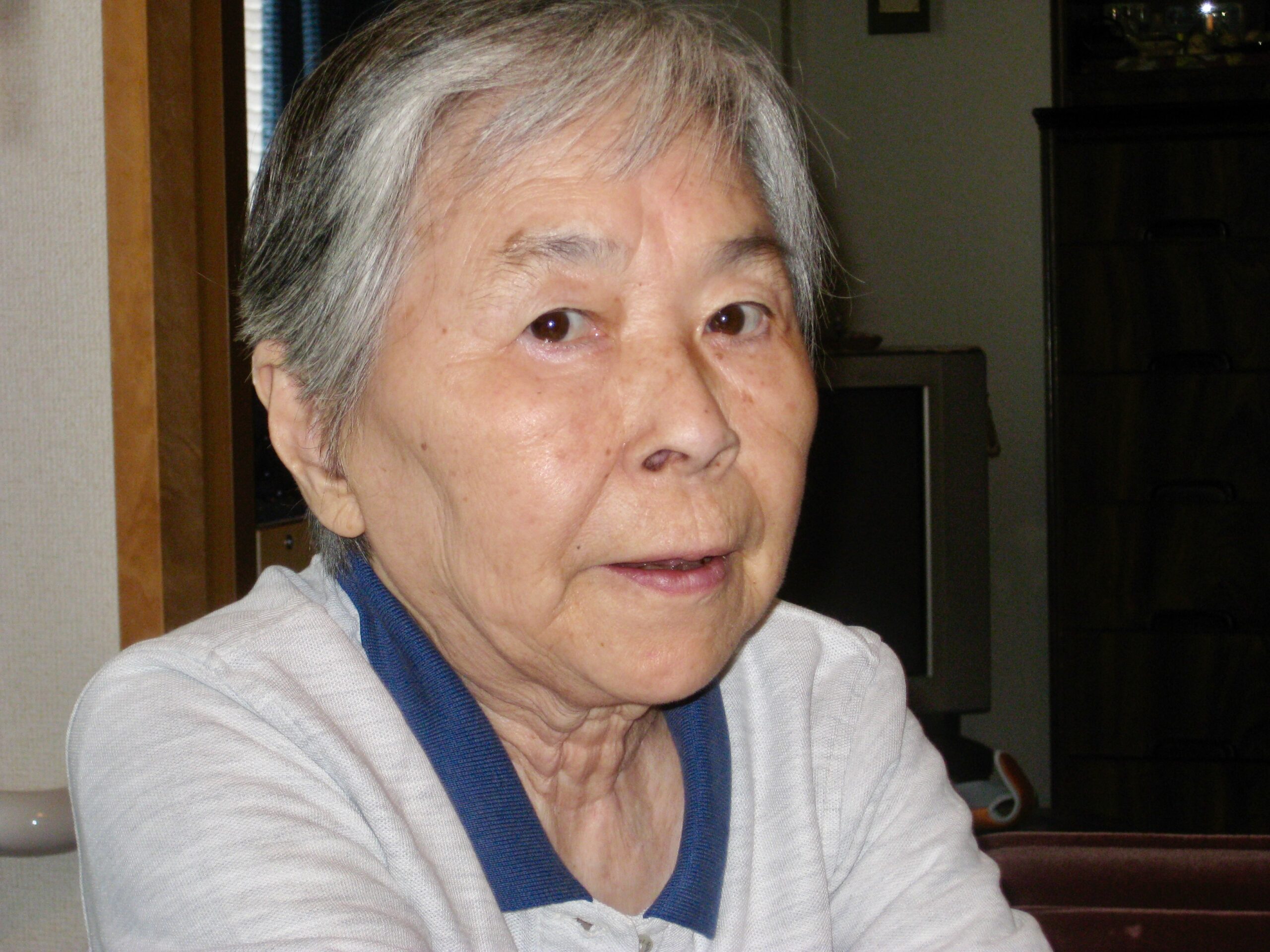
Above: Imori Kiyoko during a 2009 interview.
By Joe Copeland
In the elementary school near the T-shaped bridge that served as the target for the first atomic bomb used in combat, Imori Kiyoko was one of the few students to survive for any length of time. And she endured all the decades of uncertainty and, at times, isolation that followed. She was by far the longest-lived of all the students and teachers at Honkawa Elementary School.
Before her death in 2016, she had been in fragile health for many years with conditions likely associated with her radiation exposure. Despite the health issues, she was sharp, lively, and cheerful when I met her at her Yokohama home in 2009. Imori became bedridden after being hospitalized with pneumonia in October 2013, according to Hiroshima’s daily paper, the Chugoku Shimbun.[i]H
Imori had moved many years earlier to Yokohama, where in later years she occasionally talked to school groups about her experience and the need for peace. After turning 40, she had recurring bouts with cancer and a variety of health ailments, but she was pleasant and energetic as we talked on a late August afternoon in 2009. And she quickly began talking about the events of August 6.[ii] She recalled it as a day that started with beautiful weather, sunny and cloudless. It was, in fact, just what U.S. aircrews and their support team had wanted, a day with perfect visibility, so they .
From her house in Hiroshima, it was a good walk, she told me, about 1.5 kilometers, about a mile, to the Honkawa school, which was near a distinctive T-shaped bridge. Allied planners had chosen the bridge as the target for the bombing crew, because the shape made it so easy to spot from the air. Honkawa wasn’t the neighborhood school she might have normally attended, but her father thought it would be a good one. Indeed, according to the Chugoku Shimbun article, she could have been evacuated with other elementary school children moved to the safety of the countryside as U.S. bombers gained control of the skies late in World War II, freely bombing cities. But families could also choose to keep children at home. Imori said in our interview, “I was supposed to have been evacuated but I did not want to leave my parents.”[iii] It was her father who decided that if the family were going to die, they should be together, she said.[iv]
“That morning (Aug. 6), my father … had a day off so he was at home,” Kiyoko said in our interview.[v] Growing shortages caused by Japan’s war troubles led to electricity rationing, and his workplace had closed for the day to save energy.
A little brother also was home, along with her mother, when a school friend, 11 years old like Imori, came to the house to go with her to school. “And I said goodbye to my parents and left them, for good,” Imori recalled.
As she would say during annual visits to a Yokohama school to give a speech (a version of which her husband had printed in English and gave to me), Japan faced shortages and she was always hungry. While doing their best under the circumstances, people were eager for an end to the war. “Such were the wartime circumstances, but as for myself, I had been quite a happy girl, much loved by my parents,” she said in those talks.[vi]
She said that she and her friend, Aohara Kazuko, walked through the Honkawa school’s main gate and as required bowed in front of the school’s hoanden, a small, shrine-shaped structure in which the Emperor’s image and and an imperial order regarding education were kept. The friends then went directly to shelves along a concrete wall in one of the buildings to take off their shoes and put on the ones worn inside the school. The school was relatively modern, so iron and concrete had been used in its construction. “The moment I entered the school, the bomb was dropped,” she told me. “And it became all black inside, dark in the building. And then after a while, I saw some lights. I went out of the building and saw the entire school compound was in fires.”[vii]
She and Aohara, who had been sheltered from burns or blast injuries by the concrete wall, tried to make sense of what they were seeing. “As far as the eye could see, everything and everywhere was on raging fire,” she said in the speech to students. “It was literally a sea of fire. We saw flames gushing out of the windows of the school building we had just rushed out of. In spite of the scorching heat, we were standing there, completely petrified.
“Then two women teachers burst out of the school building. One of the teachers was bleeding from her ear. Seeing us, they urged us to jump into the river right behind the school.”[viii]Today, a road runs between the school and the Honkawa River, and there’s a path where people bike or walk. But in 1945, the school property went right up to the river.
Tides affected the river, just a few miles away from Japan’s Inland Sea along the Pacific Ocean. “Fortunately, it was probably around high tide, and there was a lot of water in it,” she told the students. “We began to run toward the river. Suddenly, a figure whose body had been burned black came over, staggering toward us.” As she backed away, a horrified Imori managed to ask who the person was. The person answered, “I’m Takagi” — a girl in their class.
“We were too shocked for words as our classmate’s appearance had changed utterly,” her speech continued. “The teachers took Takagi to the riverbank and when they laid her down on a boat that was tied there, she passed away. Feeling unbearably hot, Aohara-san and I got in the river. Splashing water over our heads, we stayed in the water, completely dazed, watching countless corpses floating away right in front of our eyes one after another. We didn’t have the slightest ideas what had happened and what was going on.
“We weren’t sure how many hours we had been in the river, but we felt that the fires had somewhat abated, and the heat also seemed to have eased. So, we crawled out of the river up onto the bank.”
There are numerous accounts of the injured going into the water and immediately collapsing and drowning, or of simply never finding the strength to get out again. But for Imori and Aohara, the teachers’ urging them to the river proved to be the best advice, and Imori attributed her survival to escaping the fires there.
Imori was, of course, desperately worried about her family. But with the city largely destroyed by the blast and the fires, she and Aohara had no sense of where the houses should be. Numbed, they wandered about in the desolation. She told students, “I didn’t feel anything whatsoever, even when I saw countless dead bodies sprawled on the street, a streetcar completely burnt black and a corpse lying with his leg stretched across the steps, and a man, or it might be a woman, whose skin had completely peeled off and was now hanging loosely, staggering along thrusting his arms forward.”
A truck came along and picked up the two girls, taking them to a designated evacuation area outside the city. They were placed at a farmer’s house, where, despite having not eaten all day, Imori couldn’t eat the bread they were offered. “And I couldn’t drink anything, either,” she said in her speech. “There was something wrong with me.” Later she would learn that she had an acute case of radiation sickness, something that wasn’t understood at the time. “After I came down with the disease, I became unable to eat or drink anything,” she said. “In my childish mind, I thought I was probably going to die. All my hair came off and my head became as bald as an egg.”
“About a week after we were taken to the farmer’s house, Miss Aohara’s father came to take her home,” Imori also told students in her talks. “I was now completely left alone. I had no one I knew around me. Neither my father nor my mother came to take me home. I was already an orphan by then, though I didn’t know it at that time.”[ix]
Many years later, she would learn that Aohara had died about 10 days after her father came to get her. “At that point, I was the only survivor of all the 400 pupils who were at Honkawa Elementary School during the explosion.”[x]
Imori herself was soon taken from the evacuation center to live with relatives. She told me that it was much later when she learned about the rest of her family. “A neighbor lady told me that my little brother seems to have been killed by a pillar that fell right on top of him, right in front of my mother,” she said.[xi] Her parents lived another four or five days. Imori’s husband said a university professor had learned during research that the parents were housed at a temple for the few days they survived, and they seem to have been aware of each other being there. A neighbor was able to visit the mother before she died.
For Imori, being left an orphan meant that she was taken in by relatives in Kure, a naval city up the coast from Hiroshima. She moved in with an aunt on her father’s side. “Because my parents were gone, I had a very cold treatment,” she said in our interview. There were many similar stories, especially given the difficult conditions in Japan during the postwar years.
“I was related to them by blood, but was not an immediate family member of theirs,” she said in her school talks. “Besides, food was extremely scarce at that time. It was surely a heavy burden on them to have one more mouth to feed. Though I had been recovering from acute radiation sickness little by little, I was always hungry without enough food.
“I would often cry, feeling so sad and lonely, and missing my lost parents. Even now, I don’t want to remember or talk about my miserable days there.”
Her life was a drastic change from the hopeful, happy atmosphere her parents had created in the middle of wartime difficulties. She barely managed to finish middle school. “I remembered my father happily talking about sending me to girls’ high school and even to college,” she told students. “At that time [after the bombing], though, all I could do was just to survive one more day. It was beyond all hope for me to go on to high school.”[xii]
And, as many hibakusha would find, especially in the early postwar years, she tired easily. So, it was only natural, she observed, for other people to consider her lazy, a common perception of the hibakusha in Japanese society for a good number of years. She held various jobs before deciding in the early 1960s to go to Yokohama, where the job situation looked more promising. But her health continued to give her problems. “Due to my poor condition, I could only work for half the month, and I was going through many other hardships one after another,” she told students. “Then, I happened to meet a very loving and understanding person who was to be my future mother-in-law. She listened to my stories with compassion and understood the pain of atomic bomb victims. She was the person who helped me get through the continual troubles. She was warm, compassionate and sometimes strict when need be.”[xiii]
Imori met the woman’s son — Hiroteru — and they married. She was 30 years old, and they moved into a house provided by the company for whom he worked. By 1974, she began experiencing what would become decades of health problems, including removal a pancreatic tumor by doctors in Hiroshima, and cancer that led to removal of her thyroid gland. For the rest of her life — she died April 2, 2016[xiv] — she had to take medicine.

Over time, she had sought comfort in some religious sects, the Imoris told me. She repeatedly wound up feeling disappointed and even used. In retirement, Imori Hiroteru, who had interpreted for U.S. Christian missionaries in the early postwar year, studied theology and took an active role in his Protestant church. Kiyoko then decided to be baptized as a Christian, joining a church just 15 minutes’ walk from their home. It was a decision, they both said, that had brought her peace. Her husband, somewhat playfully, told me she had been a stronger character before her baptism, seeming to suggest she was mellower.[xv]
In the same vein, he talked about one of their trips to Hiroshima, where they were greeted at the airport by a crowd of journalists. It came as a surprise to her, and there was talk about her as a “miracle survivor.” Hiroteru teased, “It was only then that I learned that she was such a precious person.”
As we spoke, Kiyoko mentioned her return on the 60th anniversary. A BBC interviewer, she said, asked if she hated the United States. “I don’t hate any country, I don’t hate any country,” she said. “I told him that I hate wars.”
She said she had made a quick trip to the city for the 50th anniversary of the bombing. But they took their time for the 60th anniversary, an event marked by considerable celebration of her status as both a rare survivor from within a kilometer of the bombing and the only surviving Honkawa student. The Imoris told me that they had heard she may have been more like three-tenths of a kilometer (less than a fifth of a mile) from the hypocenter rather than the four-tenths listed on an official city site. At least one teacher was also alive in the 1970s. There was, at the time of the 60th anniversary, one other surviving student from another nearby school who had been about the same distance from the hypocenter. They got to meet with each other at the 60th anniversary event.
In a video made for Japan’s National Memorial Halls in Hiroshima and Nagasaki, Kiyokoi once said, “When I attend the memorial service for A-bomb victims, I always think how good it would have been if my parents had survived. What’s done is done. For a while I hated America. None of this would have happened if they hadn’t dropped the bomb. But that’s just how it is.”[xvi]
During our 2009 interview, the Imoris pulled out a DVD of news coverage of her 60th anniversary visit by the national public broadcaster NHK for me and an interpreter to watch. The “miraculous survivor” phrase quickly popped up. It was a heartwarming video, opening a more personal light on her emotions. “She has had a brain tumor, colorectal cancer, probably due to radiation exposure. … She feels like this may be her last visit to Hiroshima.” The news crew had followed Imori to a visit to her old school, where the oldest class, the 6th grade, had come to give annual performances of a play about her. After Imori gave a talk, a girl told her, “I have heard some of the stories, but I think you told me more.” Kiyoko urged the students to do well in their studies.
The DVD reported the meeting between Imori and the survivor from the other school, Fukuromachi. The other survivor told a reporter, “We had the same fate.” Imori said the Fukuromachi school survivor and she had shared “an experience that nobody else understands.” In a studio interview later, she said, “I wanted to meet her because there are just the two of us who came out alive out of the hypocenter.”
And Kiyoko told the interviewer, “I came 10 years ago on the 50th anniversary. It was very hectic. I forced myself to come, and I just came to the memorial ceremony and went home. But this time, I was able to spend an extra few days and was very happy to be back.”[xvii]
Toward the end of the DVD, she was asked about any specific messages she left with the Honkawa school children. The survivors, she said, “cannot forever talk about our experiences. So, I told the children that when they grow up, they must continue to tell the [younger] children about it.”
When the video ended, Hiroteru mentioned the major national newspapers and the host of other media outlets that had interviewed his wife. And he elaborated on some of the serious medical issues she had faced, adding that she had to take “a whole collection” of pills in the morning, with lunch, and before bedtime.[xviii]
He said university researchers in Hiroshima had found 40 percent abnormalities in chromosomes from her tissues. Although autopsies have been somewhat uncommon in Japan, she wanted to donate her body for research.
Her dedication to research seemed to me to speak to her continuing awareness of how she might contribute to the peace effort. An article in the summer of 2014, a beautiful piece by a reporter for the national Mainichi Shimbun,[xix] talked about scientific research involving Imori and some 70 survivors by Hiroshima University’s Research Institute for Radiation Biology and Medicine. It aimed to look at all the effects — physical, social, and psychological — of the bombing. It was their research that had led to Imori learning the details of the fate of her parents and her brother, and when I talked with them, they had mentioned the health information she had received from one of the researchers, a Dr. Kamada.
The Mainichi reporter, Takahashi Sakiko, wrote, “Physician and professor emeritus Nanao Kamada, who had stored the tapes and other records of the studies, frequently provided consultations and advice to A-bomb survivors even after his retirement. When Imori was temporarily listed in critical condition last year, he rushed to Yokohama from Hiroshima to be by her side. The approach taken by these researchers is the polar opposite of that initially taken by the U.S. Atomic Bomb Casualty Commission, which was despised by Hiroshima residents for studying but not treating them.” The commission was later replaced by the Radiation Effects Research Foundation, a joint U.S. and Japanese undertaking that — while not without its critics — had many firm supporters among the survivors.
The reporter also recalled once asking Imori what she had felt when she learned about the deaths of her parents at a temple. “Nothing, really,” Imori had said. When the Mainichi writer pressed a bit more, Imori said, “I’d always operated on the assumption that my parents don’t exist.” As the writer noted, what else could an 11-year-old do after such a disaster and being moved away from the community?
In our 2009 interview, the Imoris talked a little more about her health, and then I asked if there was any one thing that brought Mrs. Imori to Christianity. Hiroteru talked about his wife’s physical sufferings. “Before coming to the church, she was invited or seduced by some cult organizations,” he said. They claimed that she would easily be cured. Eventually she came to visit at his church.[xx]
“Then I started to study, because I wanted to be baptized,” Kiyoko said. Like her husband, she said that becoming a part of the church had made a huge difference. “I feel like I have completely changed since I started to go to church,” she said.
Hiroteru said, “She used to have a much stronger character. She was orphaned by the atomic bomb. She had to harden herself. … At times, she could even be mean.” With a small, proud smile, he said, “Here she has this beautiful, gentle expression.”
It was only after she started going to church and was baptized that Kiyoko began speaking about her experiences. She said, “I had a baptism myself, and I thought about what there was for me to do.”
Her husband said she often reflected on her being the only surviving student, thinking there must be a purpose for her survival. She said, “I must have a strong destiny.”[xxi] And, to Imori Kiyoko, at least part of that destiny became to occasionally share her experiences with young people and let them carry the message of peace forward. A museum at the school includes her testimony, which is sometimes read to visitors.[xxii]
Copyright 2025 by Joe Copeland
[i] “Hiroshima: 70 Years After the Bombing: Close Range Survivors 1,” Hiroshima Peace Media Center/Chugoku Shimbun, July 17, 2014. http://www.hiroshimapeacemedia.jp/?bombing=hiroshima-70-years-after-the-a-bombing-close-range-survivors-1. Accessed March 10, 2022.
[ii] Author interview with Imori Kiyoko and her husband, Imori Hiroteru, Aug. 24, 2009, in Yokohama. In Japanese with interpreter Maeda Akiko.
[iii] “Hiroshima: 70 Years After the Bombing: Close Range Survivors 1,” Hiroshima Peace Media Center.
[iv] In a speech she would give to students, she gave a slightly different account, attributing the decision to her parents.
[v] Author interview.
[vi] “Kiyoko’s Speech,” an eight-page document provided by Imori Hiroteru in English during the 2009 interview. Mr. Imori had served as an interpreter in postwar Japan and it was my understanding that he prepared the English version of the speech.
[vii] Author interview.
[viii] Kiyoko’s Speech.
[ix] “Kiyoko’s speech.” Details of her experiences are on pp 3-4.
[x] Ibid, p 5.
[xi] Author interview.
[xii] “Kiyoko’s speech,” p 5.
[xiii] Ibid, p 6.
[xiv] Mainichi Shimbun, “Kiyoko Imori, 82: Witness to the atomic bomb experience,” (Imori Kiyokosan, 82 sai: Hibaku taiken shougensha), April 4, 2016. https://mainichi.jp/articles/20160404/k00/00e/060/194000c. Accessed Jan. 20, 2022.
[xv] Author interview.
[xvi] The National Peace Memorial Halls for the Atomic Bombing Victims in Hiroshima and Nagasaki: Global Network. Transcript of interview recorded Sept. 28, 2006, English translation by Yurie Benjamin and Ogawa Akiko. https://www.global-peace.go.jp/en/picture/en_pic_syousai.php?gbID=1084&dt=180612151801. Accessed March 10, 2022.
[xvii] Interpretation of the video by Maeda Akiko during the author interview.
[xviii] Author interview.
[xix] The article is apparently no longer accessible on Mainichi’s English language site. Searches in English and Japanese for her name only give results back to 2016. I cited and linked to the article in an Aug. 6, 2015 article, “Atomic bomb survivors: A quest for peace,” for Crosscut, a news site in Seattle, reproducing a chapter from an ebook I had done at the time. https://www.cascadepbs.org/all/2018/02/atomic-bomb-survivors-a-quest-for-peace.
[xx] Author interview.
[xxi] Author interview.
[xxii] “US College Students Visit Atomic Bombed Elementary School,” University of Michigan College of Literature, Science, and the Arts, May 21, 2019, https://lsa.umich.edu/orgstudies/news-events/all-news/search-news/us-college-students-visit-atomic-bombed-elementary-school.html. Accessed May 4, 2023.