
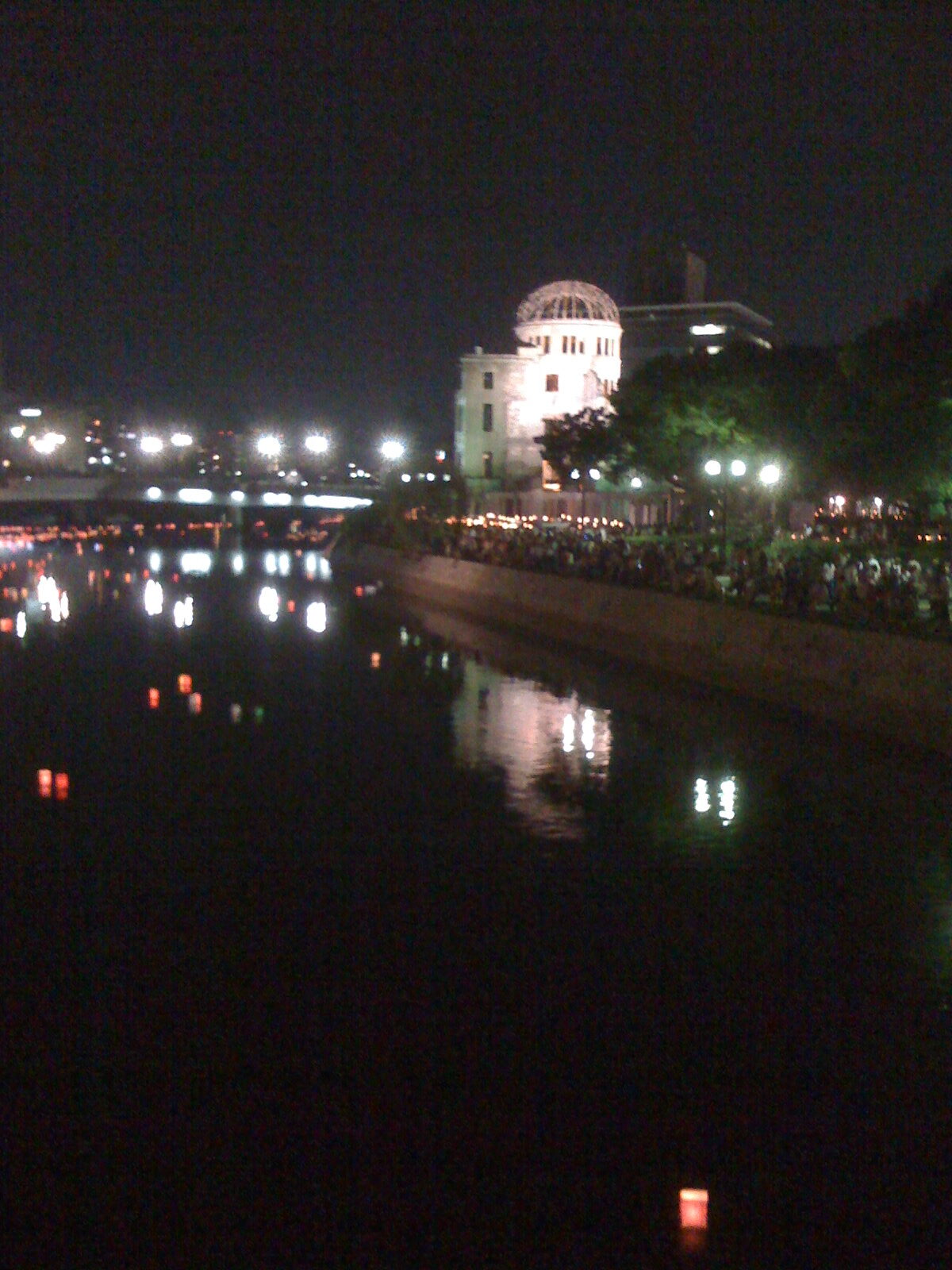
Candles float in a river in Hiroshima marking the anniversary of the Aug. 6, 1945 bombing.
By Joe Copeland
The people who survived the atomic bombings of Hiroshima and Nagasaki have spent some eight decades delivering a message to all the rest of us. No more Hiroshimas, no more Nagasakis. Humans must never again use nuclear weapons on one another.
The survivors have been at the forefront of the peace and disarmament movements that have helped maintain a tenuous, uncertain restraint on the use of nuclear weapons ever since the horrors inflicted on the two Japanese cities in August 1945. When the bombs first struck, much of the world welcomed the attacks as a critical step to the end of World War II. But that was mixed with a sense of fear and dread that science had created weapons that could well be used to wipe out civilization and perhaps all human life. Hopes that the United Nations or some other international body could quickly control nuclear weapons and power flourished briefly before dimming amid the calculated decisions of the major powers, primarily the United States and what was then Russia’s Soviet government. While the U.S. occupation authorities in Japan largely succeeded in suppressing discussion of the bombings, the voices of the survivors — known as hibakusha in Japanese — played a significant role. That was largely due to the reporting of single journalist, John Hersey, who got permission to spend two weeks in Hiroshima, where his in-depth interviews led to first an August 29, 1946 magazine account and then a book focused on a half-dozen hibakusha. It turned into an international bestseller. Throughout the years that have followed and the various movements to ban the bomb, end atmospheric testing of nuclear weapons, demand a nuclear freeze, stop the arms race and ban all nuclear weapons, the survivors’ experiences and sharing of their stories has been a key component.
Take just a few key examples. After the end of the U.S. occupation, Japan was just beginning to discuss the bombings more openly. But the United States and the Soviet Union, barely managing to maintain a pretense of interest in international control of nuclear weapons, were engaged in furious development and testing of their weaponry. In 1954, a U.S. hydrogen bomb test in the Marshall Islands’ Bikini Atoll unleashed vastly power and radioactive fallout than scientists expected. One result was that radioactive dust coated a Japanese fishing boat, sickening a crew that had no idea what was going on. When they returned home, their catch was sold to the public, but many crewmembers had to be hospitalized for radiation sickness. One crewmember eventually died of complications. It became the dominant news story in Japan, and helped kick off powerful anti-nuclear activism, including among housewives’ organizations. Influential women’s groups took up the cause, and new groups sprung up, perhaps most important among them Nihon Hidankyo (Japan Confederation of A- and H-Bomb Sufferers Organizations), which formed in 1956.
The new awareness propelled the hibakusha into Japan’s national consciousness, as well as leading to numerous trips abroad for the survivors to speak. During the decades of the Cold War, hibakusha frequently traveled not just to the United States and Russia but also to the allies of each in Europe. Hibakusha representatives were among the lead ranks of marchers and speakers in 1982 at the largest ever anti-nuclear rally ever held, in New York City. Historian Lawrence S. Witner, author of a three-volume history of the anti-nuclear movement, portrays the survivors as playing important roles all through the nuclear age. As the Cold War wound down and the United States and Russia for the first time began to agree to reduce some of their massive stocks of nuclear weapons, the hibakusha continued to insist to anyone who would listen that only the complete elimination of nuclear weapons would be an adequate safeguard against nuclear war. In the drive to launch the Treaty on the Prohibition of Nuclear Weapons in 2017, hibakusha voices played a major role, especially with the Nobel Peace Prize-winning organization, the International Campaign to Abolish Nuclear Weapons. Finally in 2024, nearly 70 years after its formation, Nihon Hidankyo received the Nobel Peace Prize for its anti-nuclear work and its advocacy for assistance to the hibakusha.
The survivors and the supporters of their calls to learn lasting lessons from the experiences of people in Nagasaki and Hiroshima built their efforts into a movement that reached out to the world. One of those outreach efforts, a program that brought U.S. journalists for a month to the two cities to interview survivors, offered me my first chance to learn about these people who chose to make tragedy, horror and suffering to change themselves into agents of peace. That led to numerous chances for me to write about the hibakusha, mainly for Seattle area readers of newspapers and online news sites, as well as in small ebook, Peace Quest: The Survivors of Hiroshima and Nagasaki, in 2015. In coming weeks and months, I will be posting additional stories of survivors, revised and expanded versions of chapters from the book, and accounts of how their movement has looked at questions of peace. This website attempts to bring their experiences, the history around their work and what I have learned from research about their work in recent years to a broader audience. In a world of continued global tensions, the survivors’ message of peace and nuclear abolition are — as the 2024 Nobel Peace Prize recognized — vital to the future of all of us.
The articles here use the Japanese naming order of family name first, followed by the given name. I’m happy to email pdf versions of the stories with all notes and page numbering to anyone interested in having full citations for research purposes: [email protected].
Copyright 2025 by Joe Copeland