
Some months after the war ended, the photographer who had taken the family’s pictures before the bombing ran into Chizuko. She had forgotten about the photo sitting. So, after the chance meeting, he came to visit her and bring the photo of the family.
By Joe Copeland
As Hiroshima has grown more distant from the experience of the bombing, the city itself has changed. A sleek, modern urban area bustles with commerce, culture, and nightlife. And, as those who survived the bombing grow older, there are the ever-present fears of not just losing them but also their experiences, their dedication to peace, and their mission of nuclear abolition. In the heart of the city, the elementary schools nearest where the bomb hit show hints of a few of the ways that new generations in Hiroshima and Nagasaki may take up responsibility for giving expression to the wishes of the hibakusha.
In what is now the downtown, Fukuromachi Elementary School has a museum right off a main street, drawing regular crowds of visitors. Exhibits show powerful pictures of the work of medical personnel who used the school, one of the early steel-and-concrete buildings in Hiroshima, as a rescue center in the weeks and months after the 1945 bombing. On some walls, survivors wrote messages looking for relatives or saying where they were. The messages, now preserved, had been covered over during work on the building and later rediscovered. The effect is powerful.
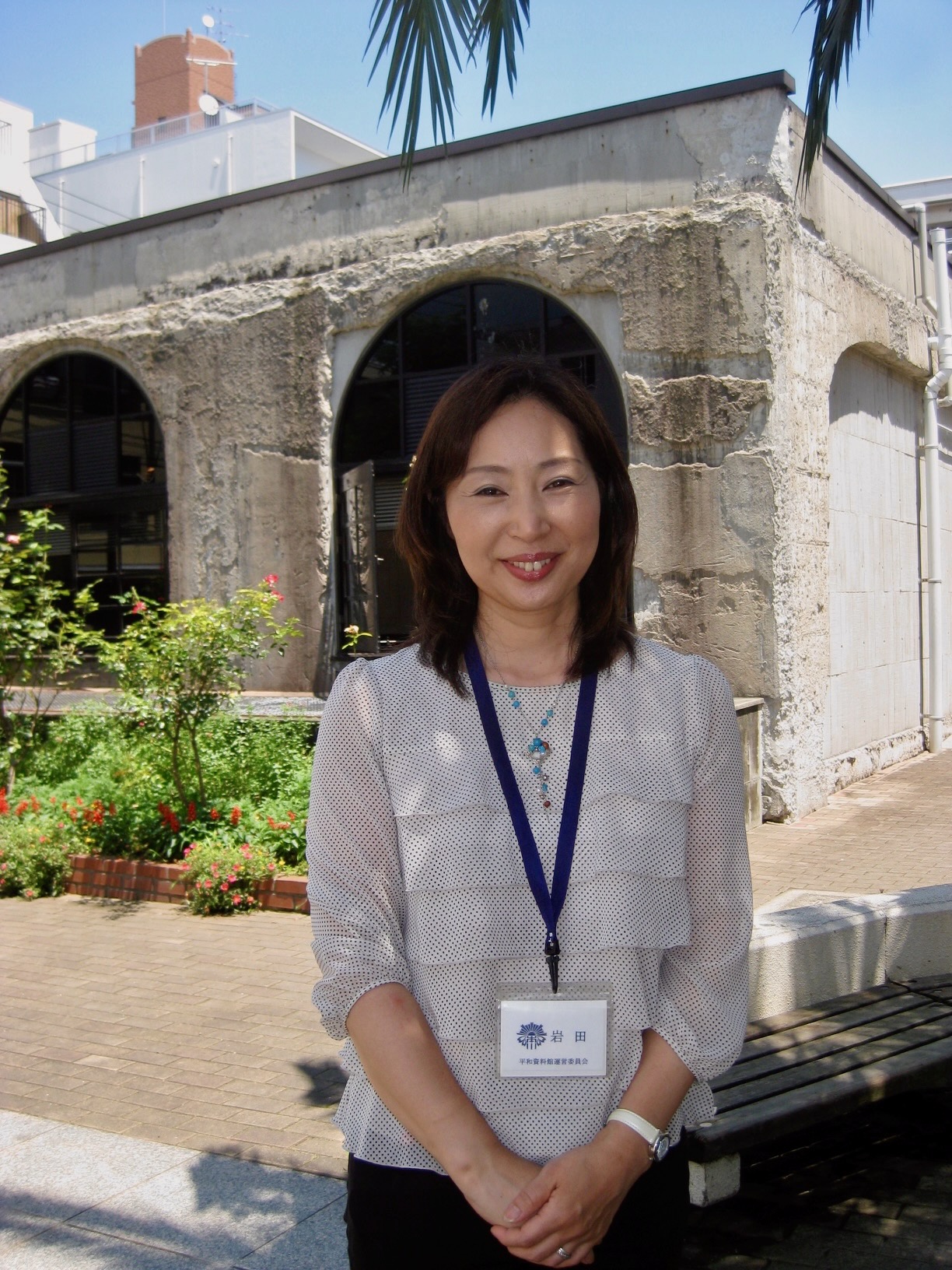
On the other side of the central city Peace Park, is Honkawa Elementary, the neighborhood school where Imori Kiyoko survived. There, my wife and I met a woman whose family was part of both the terrible history of the bombing and the hope to preserve lessons from the suffering.
Iwata Miho raised her children, now grown, with a deep family consciousness of what had happened in their neighborhood and to the neighborhood school. Iwata herself is a second-generation hibakusha, someone with a parent who experienced the bombing. And Iwata attended the rebuilt Honkawa Elementary School, as did her children. Her mother, WataokaChizuko, went to a nearby private elementary school, before going on to a public school for junior high, where she was enlisted into the wartime mobilization that put students to work.
Wataoka’s parents owned a neigborhood teashop, which was prospering during the war, and they lived there with Chizuko and three younger sisters. In the summer of 1945, the family sat for a photographer who came to their home to take their pictures. There were rumors of a big air raid striking Hiroshima, and that helped prompt the picture, Iwata told me in a 2009 interview.[i] Also, with other Japanese cities being devastated by a merciless U.S. firebombing campaign, her parents was making plans to evacuate from Hiroshima and stay with relatives in a suburban area. But the family was still living in the city on August 6, 1945.
The second oldest sister, Kayoko, 14, was in middle school, assigned like many others that summer day to what must have seemed to authorities like urgent work of demolishing buildings and clearing fire lanes in the heart of the city. The U.S. bombing raids across Japan relied heavily on napalm to light the wooden homes ablaze and create horrifying firestorms. Clearing could offer some hope of slowing or containing the fires. Kayoko was described as a lively, friendly girl.
Chizuko herself had gone early in the morning to her own mobilization assignment, in a can factory, leaving her parents and two younger sisters, 6-year-old Hirono, who was excited about being an elementary school student, and 3-year-old Kimino, still at home. Chizuko had just arrived at the factory when the atomic bomb exploded, the blast crushing the building. As Iwata recounted, Chizuko remembered coming back to consciousness and finding herself under the ruins, having to struggle to get out. She felt someone pulling her from behind, crying, “Don’t go, don’t go!” Somehow, she got out, but never really remembered how.
As it turned out, her injuries weren’t particularly serious. It was wartime, so the family had a plan in case of disaster: They would meet out in the suburbs. No one was at the house when she arrived, but eventually an uncle, who had survived in an area shielded by a hill from the direct blast, made his way there and found Chizuko.
A day or two later, she came back to her family’s house in the city. She spotted a very charred, blackened body, her father, and then found the body of her 6-year-old sister. As she checked the ruins, she found what had been the kitchen sink. There were two more bodies, seemingly charcoaled, her mother and the 3-year-old. The mother must have grabbed the little girl to protect her, in death still holding her so close that their clothes were not burned. Iwata remembered, “Mother cried and cried over the clothes.” With her uncle’s help, Chizuko cremated the bodies. There was no word about Kayoko, who had been working with so many other middle-schoolers outdoors in the middle of the city. No remains would ever be found.
Chizuko’s family was gone. So was her home — like so many in Hiroshima and Nagasaki, turned to rubble and ashes. Before the bombing, her relatives had been setting up rooms in the suburbs for her entire family of six. As Iwata said, “She felt so lonely.” So, the relatives took her in to live with them.
At age 18 or 19, she came back to the city. Relatives again helped, this time with building one of the small individual huts or cottages, called “barracks,” as the Japanese borrowed English words from the American occupiers and transformed them to suit their purposes. She was able to get back part of the family property in the Tokaichi neighborhood, a short walk from Honkawa Elementary. Since she had the assistance of relatives, Iwata said, that was better than many orphans could do in the immediate postwar period. At a time when so much of the city was unrecognizable and property records remained in a mess, many orphans were unable to claim land that should have been theirs, Iwata said. With the property in hand, Chizuko was able to start anew in the family tea business, which Iwata runs today.
Some months after the war ended, the photographer who had taken the family’s pictures before the bombing ran into Chizuko. She had forgotten about the photo sitting. So, after the chance meeting, he came to visit her and bring the photo of the family. “When she saw that picture,” Iwata said, “there was no one left in the family.” When she married and raised children of her own, she never liked to have family photos taken.

The trauma associated with the photo was longlasting. After Chizuko’s first grandson was born, Iwata and her husband decided to have a family photo, and Chizuko went along. They waited for their turn, but when the time came, Chizuko could not bring herself to be in the photo. Iwata said she was surprised at her mother’s reaction.
Iwata, active in the school PTA, sometimes showed visitors around the school’s small museum and other memorials to the students and staff lost in the bombing. One day, Iwata was telling visitors about her mother’s bombing experience, and it caught the attention of another volunteer, Amano Natsumi. After other hearings of Iwata’s story, Amano, an author of children’s books, approached her about writing about the experience. In 2006, the book was published, built around the tale of a young student and why his grandmother disliked family photos.[ii] It was a clever way of dramatizing the A-bomb history for a new generation, and in 2009 the national TV network NHK broadcast the book on a children’s program with a Tokyo actress reading the story, Iwata said. Toei, a famous company in film and anime, produced an anime version, one of a number of anime over the years about the bombings of Hiroshima and Nagasaki.[iii] In 2025, NHK produced a full 30-minute animated documentary, “Iwata’s Grandma,” broadcast internationally beginning July 31.[iv]
Besides a stylized rendering of the photo in the illustrated storybook, the photo itself was included in a postscript. The black-and-white photo shows a family whose members look warm and composed, the clothing of the children not that different from what you would see today. The father wore the “national clothing,” a rather military style that was popular in the war and frequently worn on formal occasions. He looks at the photographer intensely but with good humor. There’s something kindly about his appearance, and his pretty wife looks calm, in charge of a growing family. Chizuko, strikingly good looking at 16, is at one corner as the entire family sits on the tatami mat floor around a dark, low table. Beside Chizuko is 14-year-old Kayoko.

Iwata’s two boys graduated from the elementary school. One was chosen to read a declaration he had written at Hiroshima’s huge August 6 memorial ceremony in 2005, the main city remembrance of the bombing that is attended by thousands including national government leaders and foreign diplomats. Another year, Iwata said, his brother was a semifinalist in the citywide contest.
At the time we first talked, Iwata’s two sons were 17 and 16, Chizuko’s age at the end of the war. Iwata said she couldn’t imagine what it would be like to have her sons going off to war.
For all her family’s work on peace, Iwata emphatically said she was not optimistic about the world making the decision to give up nuclear weapons. Too few people, she said, have a real understanding of nuclear war and its consequences. Yet she continued to give tours at the school and, increasingly in the 2020s, accept a considerable number of invitations to talk about peace in Hiroshima and elsewhere in Japan. In early August of 2025, while a number of hibakusha spoke in Hiroshima and Nagasaki, Iwata visited an elementary school in Osaka to speak. In the past, any number of hibakusha would have been ready and willing to make the trip, but age has made that much harder or impossible for many of them. Iwata’s trip was representative of how second- and even third-generation survivors have begun to take on more of the responsibility for testifying to the horrors of nuclear weapons.
By 2009, Wataoka Chizuko, who died a few years later, had gone into decline, losing track of many things. But, said her daughter, the book, beautifully illustrated by artist Yuka Hamano, had made her happy. And there was one part Wataoka came to enjoy seeing: the pre-bombing picture of the family.
[i] Author interview with Iwata Miho, July 27, 2009 at Honkawa Elementary School and its peace museum, interpreted by Naganuma Naoko. Except where specified, the account is based on the interview and follow-up correspondence in subsequent years to clarify a few points.
[ii] Amano Natsumi, illustrations by Hamano Yuka, Iwata’s Grandma (Iwatakun chino Obaachan), Shufunotomo Ltd., 2006.
[iii] Nakamura Ryotaro, “Anime teaching kids about A-bombs,” Japan Times, Aug. 7, 2014, https://www.japantimes.co.jp/news/2014/08/07/national/anime-teaching-kids-about-a-bombs. Accessed March 10, 2022.
[iv] “Animation Documentary Iwata’s Grandma,” NHK World, July 31, 2025, https://www3.nhk.or.jp/nhkworld/en/thepursuitofpeace/#a_peaceOnDemand. Accessed Aug. 7, 2025. NHK said the documentary would remain available online until July 31, 2026.